

The best patios this year stopped looking like patios. They look like rooms that happen to be outside.
That’s the thread running through every outdoor living trend worth paying attention to in 2026. Here’s exactly what separates a patio that feels designed from one that just has furniture on it.
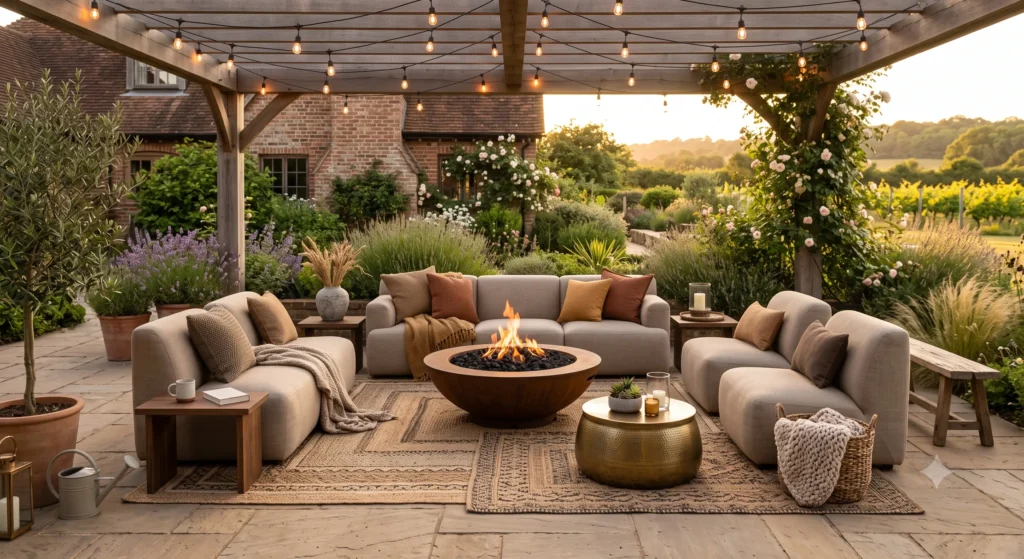
They’re Designed Like a Room, Not Decorated Like an Afterthought
The single biggest shift this year: designers are laying out patios the way they’d lay out a living room. That means a real focal point, a defined conversation zone, and furniture placed for how people actually sit and talk — not shoved against the railing because that’s where it fit.
Before you buy anything new, walk your current setup and ask where the “front” of the room is. If you can’t answer that in five seconds, that’s the gap to close first.
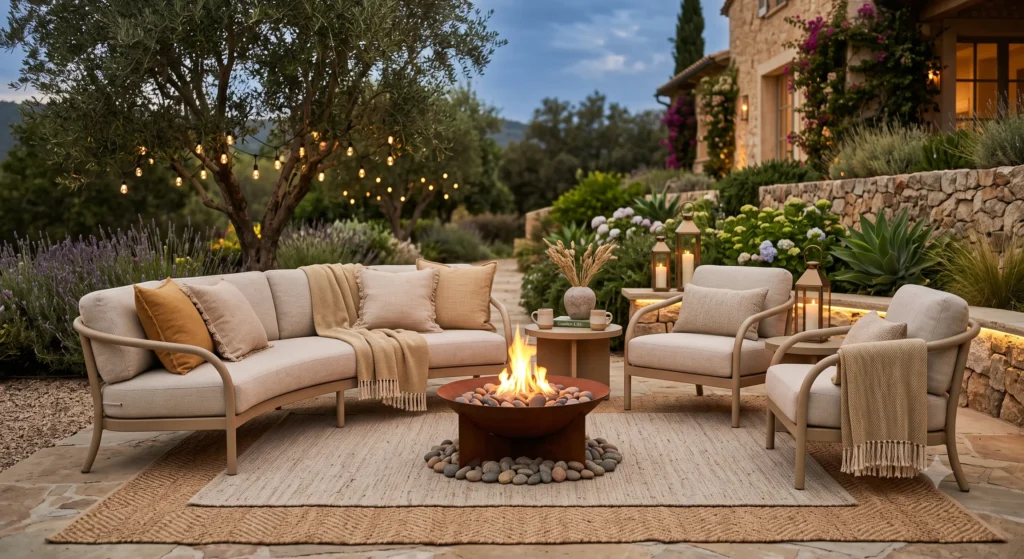
Warm Tones Replaced the Gray-Everything Era
Cool gray dominated outdoor furniture for close to a decade, mirroring the same minimalist wave that took over interiors. That’s fading fast in 2026.
Warmer finishes — flax, barley, hazel, and similar natural tones — are showing up on frames and woven furniture instead. They blend into landscaping rather than sitting on top of it, and they hold up better visually in direct sun, where cool tones can look flat and harsh.
If you’re not ready to replace furniture: a few warm-toned cushions or a woven rug can shift the whole palette without a full furniture swap.
Pergolas Do More Than Shade Now
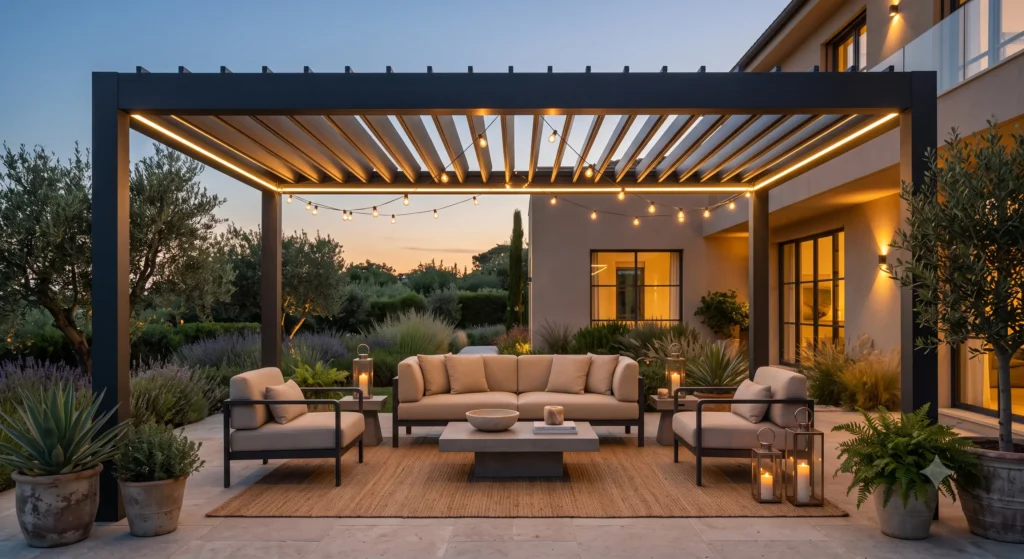
The pergola of 2026 isn’t a static frame anymore. Bioclimatic pergolas with motorized louvers adjust for light and shade, shed rain, and fold heaters and lighting directly into the structure instead of bolting them on afterward.
The result is a patio that functions across more of the year, not just the three warmest months. You don’t need the full motorized version to borrow the idea — even a fixed pergola with integrated string lighting and a discreet heater captures most of the effect.
One Patio, Three or Four Zones
Instead of a single seating cluster, the best patios this year split into distinct zones — dining, lounging, cooking, and often a fire feature — each with its own footprint.
Large-format pavers make this easier to pull off visually, since a bigger continuous surface reads as one space even when it’s serving several purposes. If your patio is smaller, two zones instead of four still applies the same logic: define where each activity happens, even loosely.
Seating Built Into the Landscape
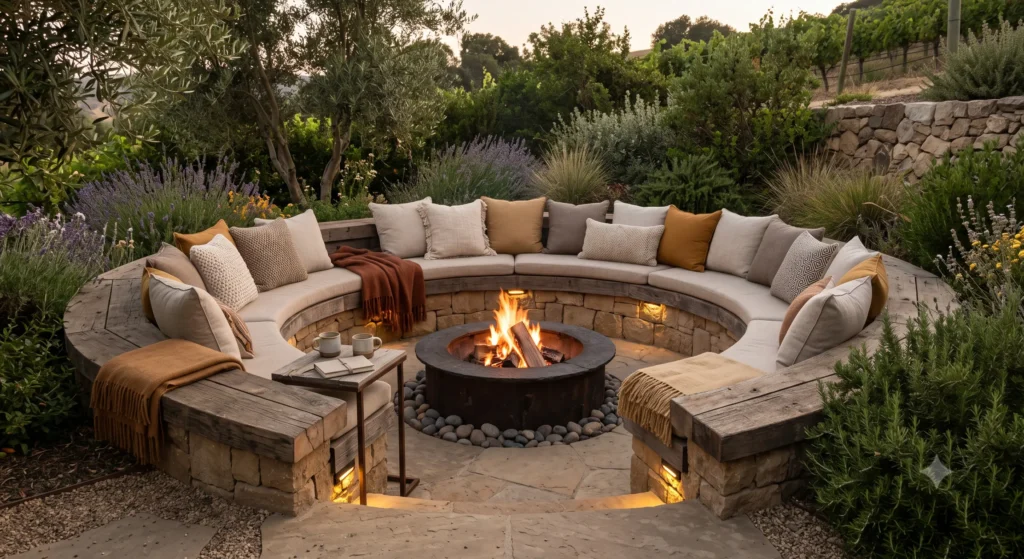
Freestanding furniture is giving ground to seating that’s built in — benches running along a retaining wall, an L-shaped ledge wrapping a fire pit, low walls doubling as extra seating during larger gatherings.
Built-in seating reads as more permanent and more architectural, and it solves a problem loose furniture can’t: it never needs to be dragged back into position after wind, rain, or a party.
Texture Layered Like a Lived-In Room
The counterpoint to all this structure: 2026 patios still lean into a relaxed, layered feel rather than looking showroom-perfect. Overlapping rugs, floor cushions positioned wherever the shade happens to fall, hand-thrown pots, and hung lanterns all show up in the same spaces as the more architectural elements above.
The placement should follow how people actually use the space, not a symmetrical plan. A patio that looks slightly imperfect often reads as more intentional than one that looks staged.
A Bold Color Finally Shows Up
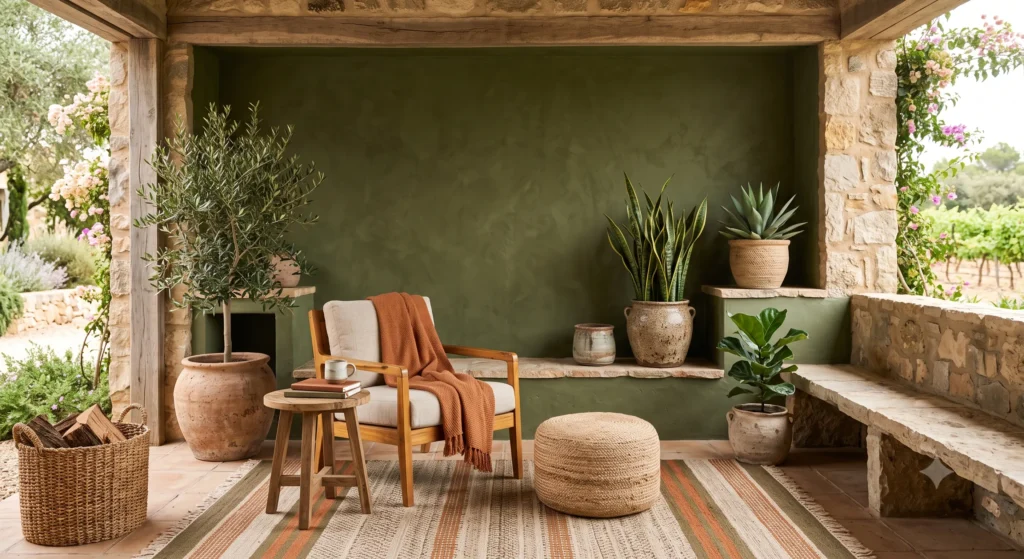
For years, color on a patio meant a cushion or a potted bloom, nothing more. That’s changing. Saturated wall and plaster tones — oxblood alcoves, deep olive edging — are showing up as intentional design choices rather than accents.
This is the easiest trend to test in a small way: one painted alcove, planter wall, or accent panel gives you the look without committing the whole space to a bold color.
Function Beats Trend-Chasing
Underneath the style shifts, the bigger story is practical. The majority of homeowners investing in outdoor spaces this year are prioritizing durability and everyday usability over decorative statement pieces — a patio that holds up and gets used matters more than one that just photographs well.
That’s worth remembering before you chase every trend on this list. The patios that actually feel good to live in are the ones where function came first and style layered on top, not the other way around.
How Many of These Does Your Patio Already Have?
Score your own space against the trends above before you plan any changes. It only takes a minute, and it tells you exactly where to focus first.
How Many 2026 Trends Does Your Patio Have?
Check off everything that’s already true for your space.
Key Takeaways
- Layout and focal points matter more in 2026 than any single furniture purchase
- Warm tones (flax, barley, hazel) are replacing the cool gray that dominated the last decade
- Pergolas now integrate light, shade control, and heat instead of just providing shade
- Zoning a patio into dining, lounging, and cooking areas reads as more finished than one big cluster
- Built-in seating is replacing some freestanding furniture, especially around fire features
- Layered, slightly imperfect styling (rugs, cushions, lanterns) still matters alongside the more architectural trends
- Durability and everyday usability are driving more purchases than pure style this year
FAQ
Do I need to renovate my whole patio to follow 2026 trends? No. Most of these trends can be tested in a small, low-cost way first — a warm-toned rug, one painted accent wall, or repositioning existing furniture around a clearer focal point.
What is a bioclimatic pergola? A pergola with motorized, adjustable louvers that control light and shade and can shed rain, often paired with integrated lighting and heating. It’s a higher-end version of the shade structure trend, but the underlying idea — built-in comfort features — can be approximated with a fixed pergola and add-ons.
Is gray outdoor furniture officially out of style? Not out entirely, but it’s no longer the default. Warmer tones are taking the lead position this year, especially in sunnier climates where cool gray can look flat in direct light.
What’s the cheapest way to update a patio for these trends? Rearranging furniture around a real focal point costs nothing and delivers the biggest visible change. After that, a warm-toned rug or cushions and one small painted accent are the next-cheapest moves.
Do small patios need to follow the “zoning” trend too? Yes, just at a smaller scale. Two zones — a seating area and a small dining spot, for example — apply the same logic as a larger four-zone patio without needing the square footage.

Daniel Carter covers the practical side of home improvement at The Dailey House — drainage fixes, DIY yard projects, patio makeovers, and the kind of weekend builds that actually get finished. If there's a smarter or cheaper way to do it, he's tested it.