

A folding desk only earns its keep if it fits three things at once: your room when it’s open, your storage spot when it’s closed, and your body while you’re actually sitting at it. Most roundups only check the first one.
Once you’ve picked a desk, our full home office decor guide and desk size guide cover the rest of the setup.
So instead of another “desks we found on Amazon” list, we ran each pick through a fit test: published manufacturer dimensions checked against standard seated-work ergonomic ranges, and against four real small-space situations — a studio corner, a bedroom alcove, a shared dining table, and a closet office. Where a desk fails one of those, we say so below.
We have not physically tested these desks. This is a specification and fit analysis built from manufacturer listings and standard ergonomic guidance, not hands-on review. Our full method is in the “How We Review” section — read it before trusting this guide, or any guide like it.
One honest heads-up before the list: all four picks below are fixed-height. None of them solve the height problem the Fit Test section flags for readers outside the roughly 5’4″–6’0″ range — see “Who Should Skip a Folding Desk Entirely” for what to do if that’s you.
Quick Picks
| Pick | Desk | Price* | Checked |
|---|---|---|---|
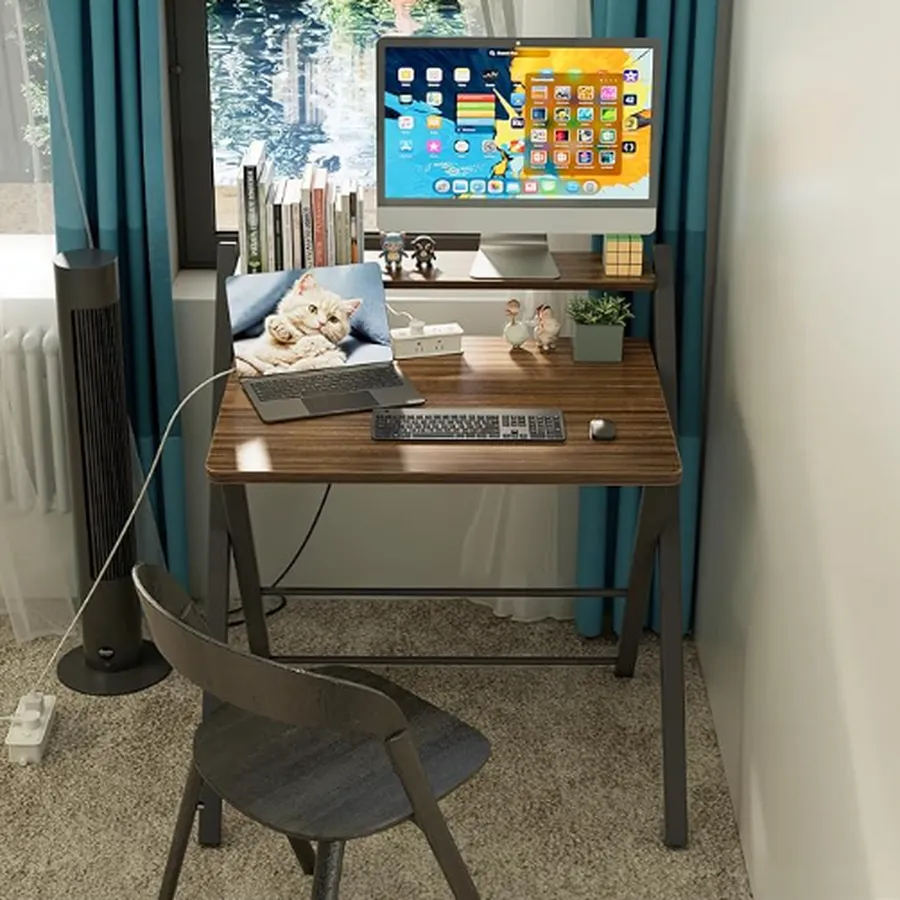
| 🥇 Best overall | GreenForest 2-Tier Folding Desk (30″) | ~$70–$110 | Jul 18, 2026 |
| 📐 Best for tight floor space | Giantex Wall-Mounted Drop-Leaf Desk | ~$59.99 | Jul 18, 2026 |
| 💵 Best budget | WOHOMO Folding Desk (31.5″) | ~$90–$105 | Jul 18, 2026 |
| 📏 Best for a wider surface | Frylr Small Folding Computer Desk (35.8″) | ~$49.99–$69.99 | Jul 18, 2026 |
*Prices change without notice and vary by color, seller, and whether power outlets are included. Confirm on the listing before buying.
The Fit Test: What Size Folding Desk Do You Actually Need?
For the full dimensions breakdown across every desk type, see our standard desk dimensions guide and its height calculator.
This is the part most folding-desk guides skip, and it’s the part that decides whether you keep the desk or resell it in four months.
Height: match the desk to your body, not the average
Standard desk height runs 28–30 inches, sized around users roughly 5’4″–6’0″ paired with an adjustable chair. Outside that band, a fixed-height folding desk puts your forearms at the wrong angle — and every desk on this list is fixed-height.
The test that matters: sit down, relax your shoulders, and let your forearms fall parallel to the floor. That’s your desk height. The gap between users can be significant — someone around 5’2″ may find their neutral height closer to 24–25 inches, while someone around 6’1″ may need closer to 28–29 inches. A fixed 29-inch desk doesn’t serve both of those people well.
- Under 5’4″: a standard ~29-inch folding desk will likely sit too high. Plan on a chair that raises, a footrest, or a lower model.
- 5’4″–6’0″: standard heights generally work with an adjustable chair.
- Over 6’0″: check knee clearance under the frame, not just surface height. Folding mechanisms and cross-braces often eat 2–3 inches of legroom.
Depth: this is where folding desks fail most often
Depth determines viewing distance, and viewing distance determines whether you get a headache by week two.
- Laptop only: roughly 18–24 inches of depth is workable.
- Single external monitor: 24 inches is the minimum most ergonomic guidance recommends.
- Dual monitors: roughly 30 inches. None of the desks below reach this — if you run two screens, a folding desk is probably the wrong category for you, full stop.
Wall-mounted drop-leaf desks are usually the biggest offenders here, though the pick below is deeper than most.
Width: what you’re really buying
- 30–36 inches: minimal to moderate setups — laptop, mug, notebook, maybe a small monitor stand.
- 60–72 inches: multitasking or dual monitors. Rare in folding designs; none of our picks below reach this.
The clearance nobody measures
You need roughly 36–48 inches of clearance behind the desk for a chair to roll back. In a small room, this is usually the binding constraint — not the desk’s own footprint. Measure the space behind where the desk will go before you measure anything else.
Comparison
| Desk | Open (W×D) | Height | Folded depth | Load capacity | Laptop | 1 monitor | 2 monitors | Studio corner | Closet office |
|---|---|---|---|---|---|---|---|---|---|
| GreenForest 30″ 2-Tier | 30″ × 24.5″ | 32.7″ overall (includes raised shelf) [UNVERIFIED desktop height] | ~1.5″ | Not published [UNVERIFIED] | ✓ | ✓ (clears the 24″ line) | ✗ | ✓ | ✗ |
| Giantex Drop-Leaf (31.5″×23.5″) | 31.5″ × 23.5″ | Mounted at your chosen height | ~2.5″ | Not published [UNVERIFIED] | ✓ | ✗ (0.5″ short of 24″) | ✗ | ✓ | ✓ |
| WOHOMO 31.5″ | 31.5″ × 15.75″ | 29.52″ (fixed) | ~2.76″ | Not published [UNVERIFIED] | ✗ (below the 18″ minimum) | ✗ | ✗ | ✓ | ✗ |
| Frylr 35.8″ | 35.8″ × 15.7″ | 28.7″ (fixed) | ~2.9″ | Not published [UNVERIFIED] | ✗ (below the 18″ minimum) | ✗ | ✗ | ✓ | ✗ |
Monitor columns are checked against the 18–24 in (single) and 30 in (dual) viewing-distance guidance above. “Studio corner” and “closet office” assume roughly 36 in of chair clearance where the desk requires a seated posture.
The Desks
GreenForest 2-Tier Folding Desk (30″) — Best Overall
A fold-flat desk with a raised back shelf, no tools required. At 30″ wide and 24.5″ deep, it’s the only freestanding pick here deep enough to clear the single-monitor viewing-distance guideline, and the shelf gives you somewhere to put a monitor, printer, or plant that most folding desks skip entirely.
Specs at a glance:
- 30″W × 24.5″D open; the 32.7″ figure in the listing is overall unit height including the raised back shelf, not necessarily the desktop surface height — worth confirming which number applies before you buy [UNVERIFIED]
- Folds to about 1.5″ thick
- No published weight capacity [UNVERIFIED]
Best for: A studio corner or bedroom setup where you want real desktop depth and a spot to elevate a monitor, without needing an actual monitor arm.
Skip it if: You need a confirmed weight rating before adding hardware, or you specifically need the shelf height (not just the desktop height) to fall in the 28–30″ ergonomic band — the listing doesn’t separate the two clearly.
Giantex Wall-Mounted Drop-Leaf Desk — Best for Tight Floor Space
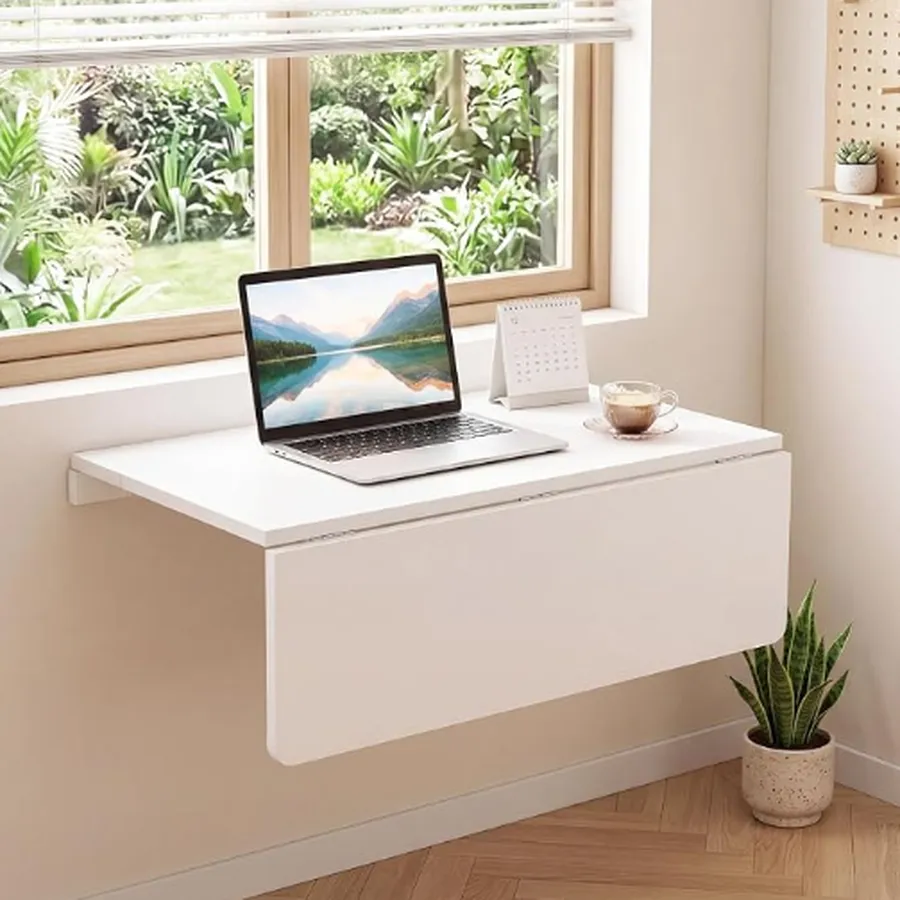
A wooden drop-leaf “Murphy desk” that mounts flush to the wall and folds down to about 2.5 inches thick when closed. At 23.5 inches of depth when fully open, it’s deeper than most wall-mounted folding desks — just half an inch short of the single-monitor depth line — and it’s the one pick on this list that genuinely fits a closet-office setup, since it needs zero floor clearance when folded.
Specs at a glance:
- 31.5″W × 23.5″D fully open; folds flat to about 2.5″ thick
- Half-open positions available at 14″ or 9.5″ deep for lighter tasks
- Pine wood + MDF + metal construction, about 9 lb net weight
- Mounts to solid walls (cement/brick per the listing) — confirm stud-mounting compatibility for drywall before installing [UNVERIFIED]
- No published weight capacity [UNVERIFIED]
Best for: Closet offices, hallway nooks, and studio apartments where floor space is the actual constraint, not surface area.
Skip it if: You rent and can’t drill into the wall, or you want something you can relocate in five minutes — this is a semi-permanent install, not a fold-and-carry desk.
WOHOMO Folding Desk (31.5″) — Best Budget
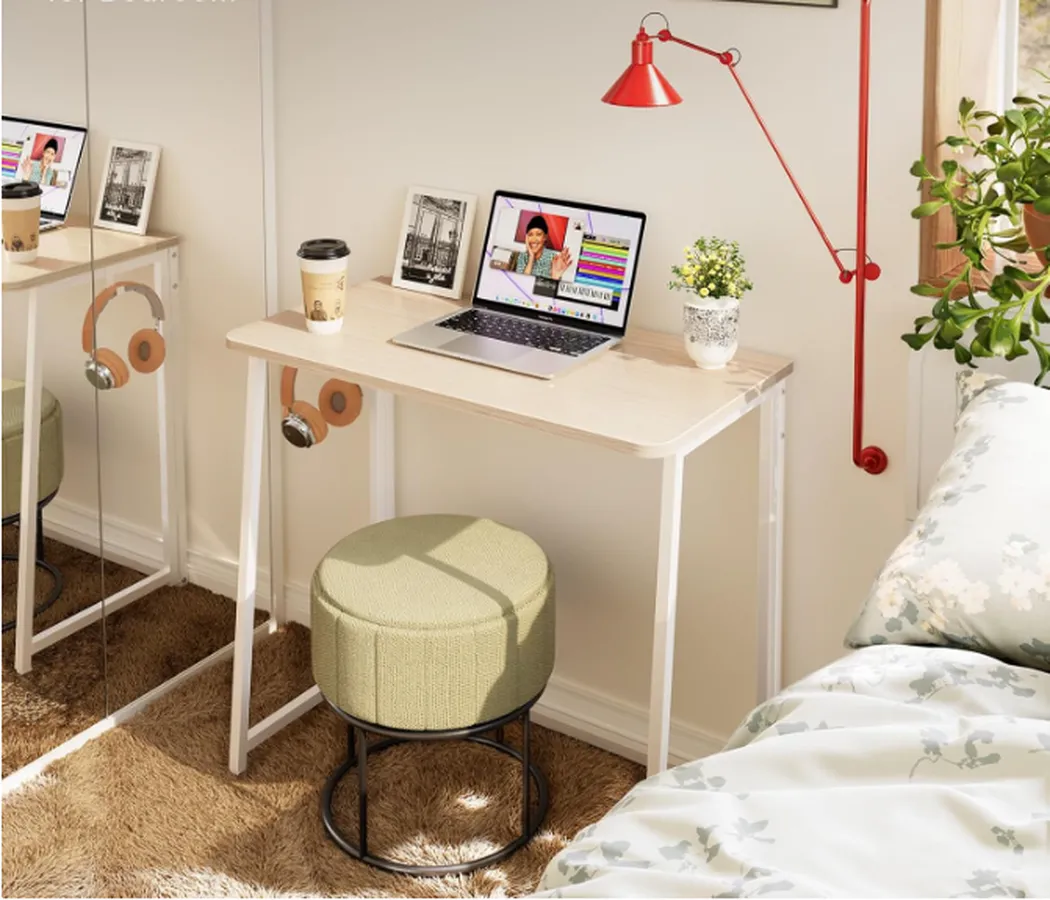
A bare-bones flat-top folding desk. At 15.75 inches deep, it’s tighter than the 18-inch minimum most ergonomic guidance recommends for laptop use — workable, but not spacious.
Specs at a glance:
- 31.5″W × 15.75″D × 29.52″H open; folds to about 2.76″ thick
- No published weight capacity [UNVERIFIED]
Best for: A dorm room or first apartment where budget matters more than depth, and the setup is laptop-only.
Skip it if: You want to add even a single external monitor — 15.75 inches of depth isn’t enough room to sit at a comfortable viewing distance.
Frylr Small Folding Computer Desk (35.8″) — Best for a Wider Surface
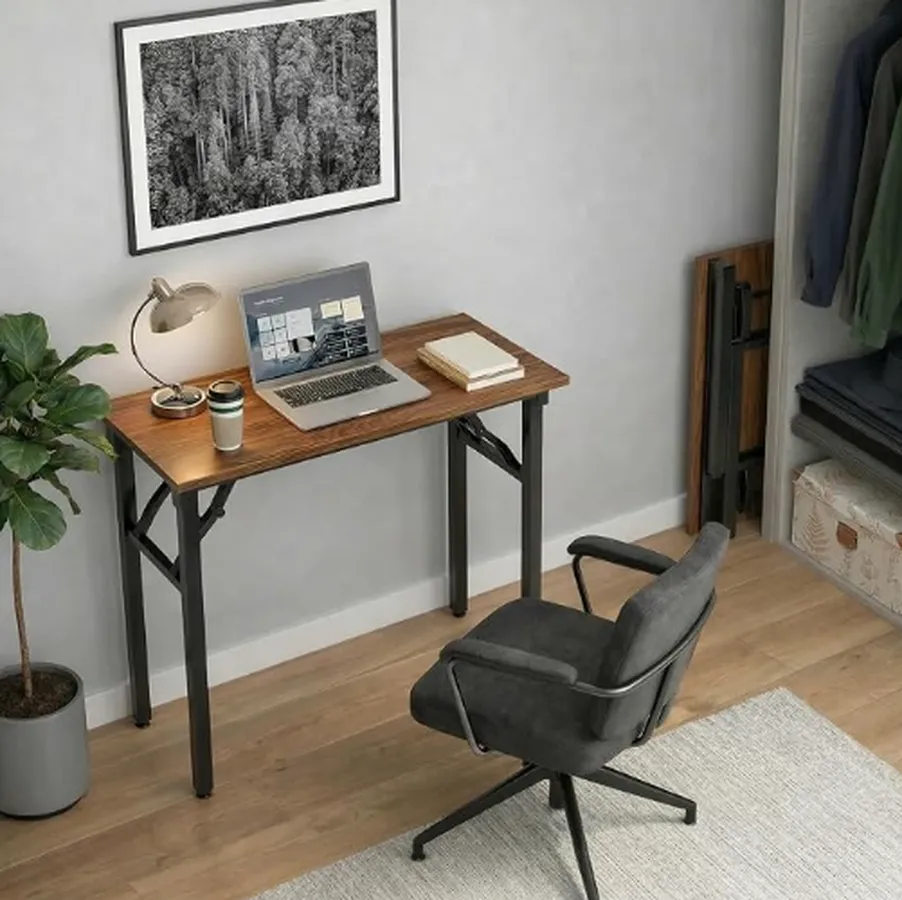
Same shallow 15.7″ depth as the WOHOMO pick above, but 4.3 inches wider — the extra width doesn’t buy you monitor room, but it does buy you side-by-side space for a laptop, a notebook, and a coffee cup without things crowding the edge. It’s also the one freestanding pick here with adjustable leg pads built in for leveling on uneven floors, per the manufacturer’s listing.
Specs at a glance:
- 35.8″W × 15.7″D × 28.7″H open; folds to about 2.9″ thick
- Adjustable leg levelers for uneven floors, per the listing
- No published weight capacity [UNVERIFIED]
Best for: Readers who want more elbow room on the surface than the WOHOMO pick offers, without paying for extra depth they can’t use anyway — or anyone setting up on an uneven floor (an unfinished basement, an older apartment) where the leveling pads matter.
Skip it if: You need actual depth for a monitor — this pick and the WOHOMO above are functionally tied on that front, both short of the 18″ laptop-depth minimum.
Who Should Skip a Folding Desk Entirely
A guide where every option is a good fit for everyone is a guide nobody should trust. Folding desks — and specifically the four fixed-height picks above — are genuinely the wrong choice for some readers:
- Dual-monitor users. None of the desks above reach the 30-inch depth two screens need. You’ll sit too close and feel it within a couple of weeks.
- Anyone outside the roughly 5’4″–6’0″ range. All four picks in this guide are fixed-height. If you’re noticeably taller or shorter than that band, none of them will give you a correct forearm angle — you’d need a height-adjustable desk instead, which is a different product category from what’s covered here.
- Anyone working more than about four hours a day at the desk. Fixed height plus shallow depth compounds over long sessions — and three of the four picks here are shallower than the recommended laptop-depth minimum.
- People who won’t actually fold it. If it stays open permanently, you’ve bought a smaller, less stable desk for the price of a better fixed one. Be honest with yourself here — it’s the single most common regret in this category.
How to Choose
Freestanding vs. wall-mounted
Freestanding folding desks (GreenForest, WOHOMO, and Frylr here) collapse flat and store behind a door, under a bed, or against a wall. They need somewhere to go when folded — a step people forget to plan for.
Wall-mounted drop-leaf desks (the Giantex pick) take zero floor space when closed, which makes them the better answer in a genuinely small room or a closet-office setup. The trade-offs are real: you need a solid wall or studs to mount into, the surface is often shallower once folded down partway, and it’s a semi-permanent change — which matters if you rent.
Materials, briefly
Most budget folding desks use particleboard or engineered wood over a steel frame. That’s fine for a laptop and light use. It’s not built for a heavy monitor arm, and it won’t hold up to damp conditions — which rules it out for a converted porch or an unheated space. None of the four desks above publish a weight capacity we could independently verify.
How We Review
We think buying guides should say plainly what they did and didn’t do.
- We did not physically test these desks. No one at The Dailey House has assembled or used the models listed here.
- The fit analysis is ours. We took published manufacturer dimensions and checked them against standard ergonomic ranges for seated work, plus four small-space scenarios with realistic chair clearance. The fit verdicts in the comparison table are our own calculation, not a manufacturer claim.
- Specifications come from each manufacturer’s own listing, recorded on the date shown. We don’t copy specs from other review sites, because errors propagate that way.
- Prices are recorded with a date and change without notice. Check before buying.
- Affiliate commissions fund the site and do not influence what appears here.
Frequently Asked Questions
What height should a folding desk be?
Standard is 28–30 inches, suited to users roughly 5’4″–6’0″ with an adjustable chair. The reliable test: sit with relaxed shoulders and let your forearms rest parallel to the floor — that’s your desk height. All four desks in this guide are fixed-height, so this test matters more here than it would for an adjustable desk.
How deep does a folding desk need to be?
Roughly 18–24 inches for a laptop, 24 inches minimum for a single monitor, and 30 inches for dual monitors. Of the four desks in this guide, only the GreenForest reaches the 24-inch single-monitor line; the rest are shallower than the laptop-depth minimum.
Are folding desks sturdy enough for daily work?
For a laptop and light daily use, generally yes, based on the construction details published by each manufacturer. None of the four picks here publish a weight capacity, though, so we can’t confirm a specific limit — ask the seller if you plan to add a monitor arm or heavier equipment.
How much space do I need behind the desk?
Roughly 36–48 inches of clearance for a chair to roll back comfortably. In small rooms, this is usually the real constraint — measure it before you shop, not the desk’s footprint.
Can I use a folding desk without wall-mounting?
Yes — the GreenForest, WOHOMO, and Frylr picks above are all freestanding and need no mounting. That’s the right choice for renters or anyone who can’t drill into a wall. You do need a planned storage spot for when it’s folded, or it simply stays open.
Final Thoughts
If you fall inside the 5’4″–6’0″ range and want the most usable depth for a laptop or a single monitor, the GreenForest 30″ 2-Tier is the safest default. If your floor space is the actual constraint — a closet office, a hallway nook — the Giantex wall-mounted drop-leaf is the only pick here built for that. If budget is the priority, the WOHOMO gets you there. And if you want a bit more elbow room on the surface or you’re dealing with an uneven floor, the Frylr is the widest option in the group. None of these four solve the height-adjustability problem — if that’s your actual issue, you’re shopping in a different category.
July 18, 2026 — First published. Specifications and prices recorded from manufacturer listings on this date.

Daniel Carter covers the practical side of home improvement at The Dailey House — drainage fixes, DIY yard projects, patio makeovers, and the kind of weekend builds that actually get finished. If there's a smarter or cheaper way to do it, he's tested it.