

You check Slack from bed. You eat dinner at your desk. You fall asleep with your laptop still open next to you.
Sound familiar?
Your studio apartment isn’t the problem. The problem is that your bed, your desk, and your couch all share the same twelve feet of floor space — and your brain has no idea which “mode” to be in.
I’ve been there. I spent eight months in a 380 square foot studio in Chicago where my office was three feet from my bed. I thought I just needed better willpower. I didn’t. I needed better zones.
Here’s the thing most articles won’t tell you: this isn’t really a design problem. It’s a brain problem. And once you fix the layout, the mental fog lifts faster than you’d expect.
This guide is different from what you’ve read before. Every method in here is tagged as renter-safe or not. Every idea has a real price range. And there’s a planning step that most people skip entirely — that step is why they end up moving furniture three times and still feeling stuck.
Let’s start before you touch a single piece of furniture.
Every studio needs these zones — and only these zones.
The most important zone. Your brain links this space to sleep — or to stress. Keep all work out of it. Separate with a bookcase, canopy, or heavy curtain.
Priority 1 — Do this firstNear the window, facing into the room — not the wall. One lamp defines this zone better than any divider. Turning it off at day’s end becomes a shutdown ritual.
Priority 2 — WFH residents onlyFloat the sofa off the wall. Use a 5×8 rug minimum — all front legs must sit on it. A floor lamp plus a plant makes this zone feel like a real room.
Priority 3 — Anchored by the rugThe invisible zone. Sound is what makes a studio feel like one room. Rugs absorb it. Books diffuse it. A white noise machine ($35) creates a sound boundary around your sleep zone.
Add-on — Often the highest ROIWhy Your Brain Needs Zones (Even in a Tiny Space)
Think about the last time you tried to relax on your couch but ended up thinking about work. Or tried to fall asleep but kept staring at your desk from bed.
That’s not laziness. That’s your brain doing exactly what it’s built to do.
Your brain links places to behaviors. Sleep researchers call this “stimulus control.” Jeff Kahn, co-founder of Rise Science, a sleep research company, puts it plainly: “Avoid doing work or anything stressful from your bed.
This helps maintain what sleep medicine practitioners call stimulus control, which helps your brain associate the bed with sleep rather than wakefulness and stress.”
In other words, if you work, scroll, and stress in the same spot you sleep, your brain stops treating that spot as a sleep signal.
And the numbers make this even more urgent right now. About 22% of the U.S. workforce works remotely as of 2025. That’s roughly 32.6 million people — many of them in studios — bringing their full work life into the same 440 square feet where they eat, sleep, and try to decompress. (440 square feet is the U.S. average studio size, according to HireAHelper’s 2025 data. Most are smaller.)
Research published in Springer Nature confirms what that Chicago apartment taught me the hard way: clear delineation between different functional areas significantly improves how people feel and function in small home spaces, especially during work-from-home arrangements.
There’s also a sleep science angle that nobody talks about in apartment design articles. A 2025 review in Indoor Air found that nighttime noise above roughly 35 dB is linked to REM sleep disruption.
Blue light above 30 to 50 lux in the evening disrupts your body’s sleep signals. When your workspace and sleep space share the same air, both problems get worse.
You don’t need more square footage. You need better-defined space.
And here’s the good news: you can do this for under $150 without drilling a single hole.
Why Your Brain Needs Different Spaces
It’s not about décor. It’s about how your brain reads physical cues.
Your brain links spaces to behaviors. If you work, eat, and stress in the same spot you sleep, your brain stops treating that space as a sleep signal. Sleep researcher Jeff Kahn calls this “stimulus control” — and it’s why your sleep zone must be visually separate.
Source: Rise Science / The Columbian, 2024Keyboard clicks, a TV in the living zone, or ambient noise from the kitchen — in an undefined studio, all of it reaches your bed. Noise above 35 dB at night disrupts REM sleep. A bookcase between zones isn’t just visual — it absorbs sound too.
Source: Indoor Air, Wiley, 2025 reviewA laptop screen or cool-white desk lamp near your bed throws off your circadian rhythm. Keep all screens and task lighting away from the sleep zone. Warm-tone lamps (2700K or lower) in the sleep zone only.
Source: Indoor Air, Wiley, 2025 reviewThat’s 32.6 million people — many in studios — bringing their full work life into a 440 sq ft space. Poor spatial separation during remote work is directly linked to higher fatigue. Zoning isn’t optional for WFH studio residents. It’s essential.
Source: Neat / Frontiers in Psychology, 2023Before You Buy Anything: Map Your Zones First
Most articles skip straight to “buy a bookcase.” Don’t.
Spend 20 minutes doing this planning step and every furniture decision after it becomes obvious. Skip it and you’ll end up with a beautiful bookcase in exactly the wrong spot.
Step 1: Decide which zones you actually need
Most studios need three or four zones, not six. The core ones are: sleep, work, lounge, and eat. That’s it.
If you rarely cook at home, your eating zone can merge with the lounge zone. A coffee table handles most of what a dining table does in a small space. If you work in an office five days a week, you probably don’t need a dedicated home office zone at all.
Over-zoning is a real mistake. Trying to carve out six distinct areas in 400 square feet doesn’t create more rooms. It creates a cluttered obstacle course.
Step 2: Find your room’s natural anchors
Every studio has fixed features that already hint at where zones should go. These are your anchors.
Where is the window? That’s your best natural light source. It belongs to whichever zone most needs good light — usually the work zone or the lounge area.
Where does the kitchen end? That edge is a built-in boundary. Your eating zone naturally sits nearby.
Where does the door open? That entry point is naturally transitional. Even a small coat hook and a tiny mat there creates a “decompression zone” — a place your brain registers as the gap between outside and inside.
Here’s a concrete example. Picture a 420 square foot rectangular studio with one window wall and a kitchen tucked into the corner. A smart layout might look like this: sleep zone against the far interior wall, away from street noise and kitchen smells; work zone near the window where the light is best; lounge zone anchored in the middle with a sofa; kitchen zone already fixed by the building.
Nothing was bought yet. Just moved.
Step 3: Rank by priority, not by size
The zone that most affects your daily mood gets the best spot. Not the biggest furniture. Not the most expensive setup. The best location.
For most people, that’s either the sleep zone or the work zone. Most people default to pushing the bed against the nicest wall out of habit. Try asking instead: which zone do I spend the most waking hours in? That one gets the window.
Now you have a plan. Everything that follows is just executing it. Try this Studio Zone Planner Quiz.
Studio Zone Planner
Answer 5 questions. Get your personal zone blueprint.
Renter-Safe vs. Permanent: Know Before You Spend
If you rent — and statistically, about 35% of U.S. households do — this section might save you part of your security deposit.
Before anything else, understand the two categories:
Renter-safe means no nails, no drilling, no paint, no adhesive that leaves residue. Everything moves with you when you leave. Your landlord never needs to know it happened.
Requires permission means wall paint, ceiling tracks that need drilling, permanent shelving, or adhesive wallpaper. Some landlords say yes. Many say no. You need to ask before spending money.
One tip that most people ignore: photograph your apartment before making any change, even a small one. And read your lease for the word “alterations.” That single word often covers far more than you’d expect.
What You Can Do Without Asking
Know which zoning methods protect your deposit before you spend a dollar.
Before any change — even moving furniture — take photos of every wall and floor. One photo can protect your entire deposit. Date-stamp them in a folder on your phone.
That one word often covers far more than you expect. In most leases, “alterations” includes painting, drilling, and permanent fixtures. Read it before spending money on anything in the “Ask” column.
Here’s a quick reference you can come back to:
| Method | Renter-Safe? |
|---|---|
| Area rug | Yes |
| Freestanding bookcase | Yes |
| Tension rod + curtain | Yes |
| Floor lamp | Yes |
| Freestanding room screen | Yes |
| Canopy bed curtain kit | Yes |
| White noise machine | Yes |
| Console table behind sofa | Yes |
| Tall potted plants | Yes |
| Ceiling curtain track (tension) | Usually yes |
| Ceiling curtain track (drilled) | Ask first |
| Wall paint / accent wall | Ask first |
| Adhesive wallpaper | Ask first |
| Wall-mounted shelving | Ask first |
Every method from this point forward is tagged. Check back here before you spend anything.
Zone 1: The Sleep Zone (Get This One Right First)
The sleep zone is the most important one to define. Not because it takes the most space, but because getting sleep wrong affects everything else — your focus, your mood, your ability to actually stop working at night.
Lisa Strauss, a psychologist who specializes in cognitive behavioral treatment of sleep disorders, recommends keeping sleep and wakefulness in separate zones even in the smallest apartments. If that’s not possible, she suggests designating different sides of the bed for different activities. That’s how serious the spatial separation principle is.
Here’s what actually works:
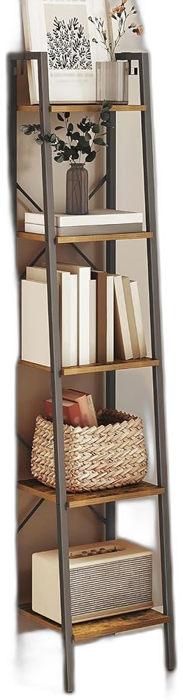
Low bookcase at the foot of the bed Renter-safe. Cost: $60 to $250. Aim for 48 to 54 inches tall — high enough to signal a boundary, low enough not to block light. Fill it with actual books. This matters because books aren’t just decoration. They absorb sound. A full bookcase between your sleep zone and your desk zone quietly reduces the acoustic bleed from one area to the other.
Tension rod curtain panel Renter-safe. Cost: $15 to $45. A ceiling-to-floor curtain on a tension rod creates a soft visual wall around the sleeping nook. You can draw it closed at night and open it in the morning. This is the highest-impact change you can make for under $50.
Canopy bed curtain kit Renter-safe. Cost: $80 to $300. This one wraps the separation around the bed itself rather than the space outside it. If you have a four-post frame or even just a ceiling hook, a canopy creates a visual “room within a room.” No external divider needed.
Positioning matters as much as furniture Put the bed against the longest interior wall, parallel to it. Face it away from your desk. That sightline change costs nothing and immediately reduces the psychological pull of work into your rest space.
Now add the acoustic layer. This is what nobody else writes about.
Research published in Indoor Air in 2025 confirmed that nighttime noise above about 35 dB disrupts REM sleep. In a studio, that threshold is easy to cross — a keyboard, a TV, even a conversation from the kitchen. Your visual zone markers also double as acoustic ones if you choose them right. Books on a shelf absorb sound. Heavy curtains reduce echo. A rug under the bed absorbs the reflected noise that hard floors bounce around the room.
One move if you only do one thing: Position the bed against the wall farthest from your desk, add a bookcase at the foot, and put a white noise machine on the nightstand. That combination costs less than $150 and creates more real separation than a $400 room screen.
Zone 2: The Work Zone (Especially If You Work from Home)
Here’s a number that might surprise you: 22% of the U.S. workforce works remotely as of 2025. If you’re one of them, your studio isn’t just home — it’s your office. That changes everything about how you need to think about the work zone.
Research published in Frontiers in Psychology found that poor “work privacy fit” — not having enough spatial separation for home-based work — is directly linked to lower wellbeing and higher work fatigue during remote work. You’re not imagining it when working from the same spot you sleep in feels draining. There’s science behind it.
Here’s how to build a work zone that feels like a separate place:
Turn the desk away from the wall Renter-safe. Cost: $0. This is the move most people never try. Instead of pushing the desk into a corner facing the wall, rotate it so it faces into the room. Suddenly it feels like a real office. The visual boundary comes from the desk’s orientation, not from any physical divider.
Floor lamp beside or behind the desk Renter-safe. Cost: $25 to $60. Light is a zone marker. A bright, cool-tone desk lamp or floor lamp (5000K to 6500K range) signals “work mode” to your brain. When you turn it off at the end of the day, that simple action becomes a physical “leaving work” ritual. This is behavior design as much as interior design.
Low-pile rug under the desk chair Renter-safe. Cost: $30 to $80. It protects the floor, defines the footprint of the work zone, and looks intentional. A 4×6 rug works here even if it feels small — the work zone doesn’t need to be large, just defined.
Open shelving on one side of the desk Renter-safe (freestanding). Cost: $60 to $200. This does two things at once. It stores work materials — notebooks, monitor, cables — and creates a soft visual wall between the work zone and the lounge zone behind it.
For studios under 300 square feet where a full desk isn’t possible: a fold-down wall desk or a dedicated bar-height counter zone at the kitchen edge can serve as the work area with the right lamp. The lamp is what makes it a zone. Without it, it’s just a surface.
The shutdown ritual is the whole point of the work zone If your zone looks different from the rest of the apartment, closing your laptop and turning off the desk lamp becomes a real signal. Your brain reads it as leaving work. That’s the reason to build the zone. Not the desk. The ritual.
Zone 3: The Lounge Zone (Your Space to Actually Decompress)
Most people put their sofa against the wall and call it a lounge zone. That’s not a zone. That’s furniture storage.
Here’s the difference: a real lounge zone has a boundary. The boundary is what makes your brain register it as a distinct space rather than just “the rest of the apartment.”
Float the sofa away from the wall Renter-safe. Cost: $0. Pull the sofa 12 to 18 inches away from the wall behind it. This single move transforms the sofa from a piece of furniture into a zone anchor. It now has a back space that separates the lounge from whatever is behind it.
Add a console table behind the sofa Renter-safe. Cost: $80 to $200. A narrow console table — 10 to 12 inches deep — placed behind the sofa creates a defined zone edge with almost no floor footprint. It also gives you a surface for a lamp, a plant, or small storage. It’s one of the most space-efficient zone markers available.
The area rug is not optional This is the number one mistake in small space design: the rug that’s too small. A 4×6 rug under a sofa doesn’t anchor a zone. It looks like a bathmat that wandered in from the bathroom.
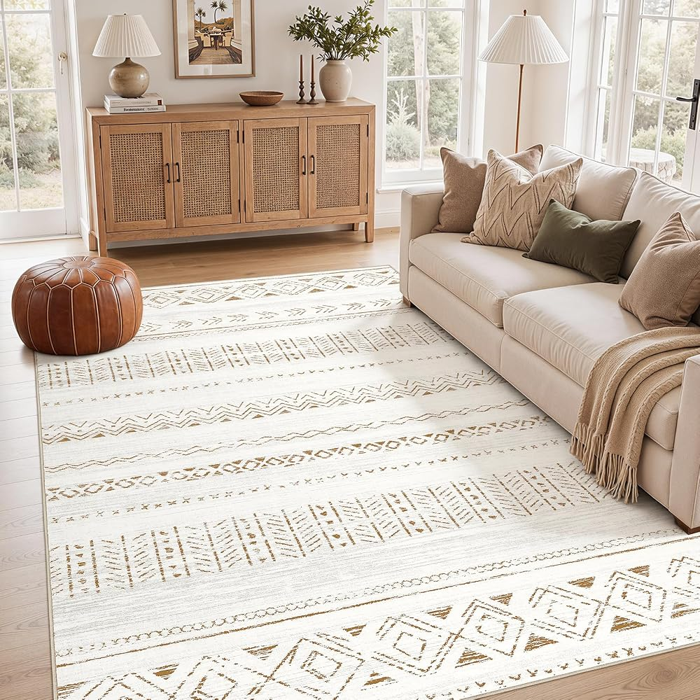
For a lounge zone, a 5×8 is the minimum. A 6×9 is better if your space allows. All front legs of your seating should sit on the rug. That’s the rule. When the rug is the right size, the lounge zone reads as a room even without any physical dividers.
If you want to make your apartment feel larger overall — not just more organized — this article on how to make a small room look bigger covers the visual tricks that work in concert with zone layouts.
Layered lighting makes the zone feel alive Overhead lighting treats your entire studio as one room. A floor lamp plus a table lamp in the lounge zone creates a warm “pool” of light that signals “rest mode” to your nervous system. This is the cheapest zone marker there is — and it works even when everything else is identical to the rest of the space.
Tall plants as soft walls A fiddle leaf fig, a bamboo palm, or a snake plant placed at the corner of your sofa zone acts as a natural filter. It breaks sightlines without blocking light. It adds height without adding weight. All three of those plants survive in moderate indoor light and need watering once a week or less.
A basic lounge zone — rug, floor lamp, one plant — can be set up for under $150 using IKEA, Wayfair, or secondhand finds.
Rug Size Checker
Stop guessing. Enter your sofa and seating to find the minimum rug that actually works.
The Zone Nobody Talks About: Sound
Here's what every other article on studio apartment zoning gets wrong: they treat it as a purely visual problem.
It's not.
Sound is what makes a studio feel like one room. You can have a beautiful bookcase between your desk and your bed. But if you can hear your keyboard from your pillow, your brain still registers it as one continuous space.
This matters for sleep more than anything else. Research published in Indoor Air confirmed that nighttime noise above about 35 dB disrupts REM sleep. In a studio apartment, sound travels freely between zones unless you actively do something about it.
Here's how sound actually works in a small space:
Hard floors reflect sound. Rugs absorb it. Every rug you add to anchor a zone is also reducing acoustic bleed between zones. This is a bonus function of the most basic zoning tool.
Bookshelves full of books are acoustic diffusers. This is why a filled bookcase between zones works better as a divider than a flat screen or a plant. The irregular surface of books breaks up sound waves. A screen just redirects them.
Heavy curtains reduce echo. Sheer curtains don't. If you're choosing a curtain as a zone divider, understand that a sheer gives you visual privacy but almost no acoustic benefit. A heavier fabric — linen, velvet, or a thick polyester blend — reduces room echo and helps your sleep zone feel quieter.
The simplest acoustic zoning tool in any price range is a white noise machine. A Marpac Dohm — the most commonly cited option by sleep researchers and therapists — costs between $25 and $50. Placed at the foot of the bed, it creates an acoustic boundary around your sleep zone without any physical divider at all. For under $50, nothing else comes close to this level of impact.
Acoustic Zoning — Zone Your Ears, Not Just Your Eyes
Visual dividers alone won't work. Sound is what makes a studio feel like one room.
In a hard-floored studio, sound bounces off every surface and fills the whole room. Every rug you add to anchor a zone also reduces acoustic bleed between zones. Two functions for the price of one.
Bonus: your cheapest zone tool is also acousticThe irregular surface of book spines breaks up sound waves and scatters them instead of reflecting them. A bookcase filled with books does more for sound separation than a flat screen or a plant. This is why it's the best zone divider.
Best visual + acoustic combo dividerIf you're choosing a curtain as a zone divider, a sheer gives you visual privacy but almost no acoustic benefit. A heavier fabric — linen, velvet, or thick polyester — actually reduces room echo. Pick heavy if you can.
Linen or velvet over sheer, every timeA white noise machine (Marpac Dohm is the most cited by sleep researchers) placed at the foot of the bed creates an acoustic boundary around your sleep zone without any physical divider at all. For under $50, nothing else comes close.
Best ROI: $25 to $50, zero floor footprintThe principle: Zone your ears, not just your eyes.
Every Method, Ranked by Budget
This is the reference section. Come back to this when you're ready to spend money.
Under $100 (Renter-safe, zero commitment)
- Rearrange existing furniture — $0. Often the highest-impact move. Turn the desk. Float the sofa. Move the bed. Do this before buying anything else.
- Tension rod and curtain panel — $15 to $45. Instant soft divider for a sleeping nook or kitchen separation.
- White noise machine — $25 to $50. Best acoustic investment for the sleep zone.
- Floor lamp — $25 to $60. The cheapest zone signal available. One lamp = one zone.
- Area rug (5x8) — $30 to $80 on IKEA, Wayfair, or Amazon. Anchors any zone visually and acoustically.
$100 to $400 (Mostly renter-safe)
- Console table behind sofa — $80 to $200. Defines the lounge zone boundary with almost no floor footprint.
- Canopy bed curtain kit — $80 to $180. Creates a sleep enclosure from the bed itself.
- Tall potted plant (fiddle leaf, snake plant) — $40 to $120. Visual zone marker that filters sightlines without blocking light.
- IKEA KALLAX bookcase (2x4 or 4x4) — $120 to $200. The single most versatile zone divider in small spaces. It works as a room divider, storage unit, and display surface at the same time.
$400 and up (Some require lease check)
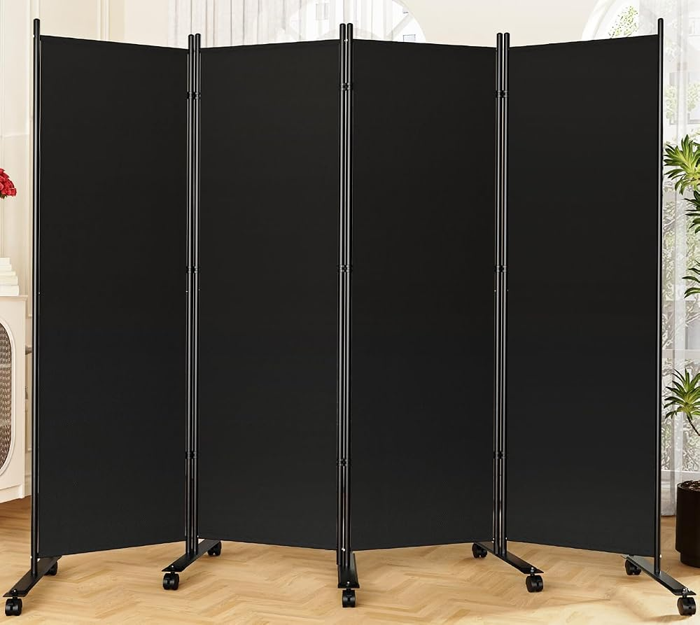
- Freestanding room screen or shoji screen — $120 to $400. Fully renter-safe. Moveable. Works in any layout.
- IKEA BILLY bookcase with ceiling rail bracket — $200 to $400. Floor-to-ceiling without drilling if installed with a rail system. Fully renter-safe. Highest visual impact in this category.
- Ceiling curtain track (tension version) — $150 to $350. No drilling required for tension models. Highest overall impact for separating a sleeping nook.
One note before you buy anything tall: measure your ceiling height. Standard room dividers are built for 8-foot ceilings. Many older studio buildings have 9 or 10-foot ceilings. Check before you order.
Zone Budget Calculator
Set your budget, pick your zones, and get a renter-safe shopping list.
5 Mistakes That Make Your Studio Feel Worse
Before you start moving things, know what not to do. These five mistakes are the most common ones, and each one makes a studio feel smaller, not more organized.
1. Over-zoning Three zones is the maximum for most studios under 450 square feet. Four works for 450 to 600 square feet. If you're trying to create five or six distinct areas in under 400 square feet, you're not creating rooms. You're creating a maze. Pick the zones that matter most to your daily life and stop there.
2. The rug that's too small A 4x6 rug under a sofa is the most common small space mistake there is. It doesn't anchor anything. The rule: all front legs of seating must sit on the rug. Below that size, you might as well not have one.
3. Putting a divider in front of the window A bookcase or screen placed between your main light source and the rest of the room creates a dark zone behind it. Dividers should run parallel to light sources, not perpendicular to them. Light needs to flow in and across the space, not get blocked six feet from the window.
4. Buying before measuring A console table behind a sofa sounds perfect until you realize it leaves you 22 inches of clearance to the wall. That's not enough to walk through comfortably. The minimum for main walkways is 36 inches. For secondary paths, 24 inches. Measure before you buy.
5. Ignoring the ceiling Ceiling-hung plants, pendant lights, and curtain tracks cost zero floor footprint. Most studio residents never look up when thinking about zoning. That's free real estate. If your floor space is maxed out, go vertical.
Where to Start Today (Not Next Weekend)
You don't need to do all of this at once.
Here's the order that makes the most sense:
- Sketch your floor plan on paper. Mark your anchors: window, door, kitchen edge.
- Decide which three zones you need.
- Move your existing furniture to match the plan. This costs nothing.
- Add one rug to anchor the lounge zone.
- Add one lamp to each other zone.
That sequence costs under $150 if you need to buy anything at all. And it will change how your apartment feels within a day.
The most common thing I hear from people after doing this: "I didn't realize how much the open space was stressing me out until it wasn't anymore."
Dividing a studio apartment into zones without walls doesn't require a renovation. It requires intention. A 440 square foot space can function as a sleep sanctuary, a productive workspace, and a real lounge area — all in the same room, all at the same time.
Start with the rug. Place it in your lounge zone. Make sure both front legs of your sofa sit on it.
That one move is the foundation of everything else.
For more ways to visually expand a small space while you're setting up your zones, see this guide on how to make a small room look bigger.
Small-Space Picks That Help
Related Guides

Olivia Bennett is the Lead Content Editor at The Dailey House. She specializes in interior styling, bedroom aesthetics, and creating spaces that feel intentional without feeling out of reach. With over a decade of experience covering home interiors, Olivia believes every room should tell you something about the person who lives in it.