

You’ve tried moving the furniture around. You added a mirror. Maybe you even bought new throw pillows. And the room still feels like it’s closing in on you.
Here’s the truth: most advice about small rooms is vague. “Paint it white.” “Use mirrors.” “Declutter.” Nobody tells you where to start. Nobody tells you what actually moves the needle.
This guide does both.
The average U.S. apartment is 908 square feet, and more than half of all new apartments built are studios or one-bedrooms (RentCafe, 2025). Small spaces are the norm now, not the exception. So if your room feels cramped, you’re not alone, and you’re not stuck.
We’ll go through eight areas in order of impact. Start at the top. By the time you finish reading, you’ll know exactly what to do first, what it costs, and why it works.
And if you rent and can’t paint or drill, there’s a full section at the end just for you.
The data behind small rooms in the US right now — and why design matters more than square footage.
Why Your Room Feels Smaller Than It Actually Is
Before we fix anything, you need to know what’s actually happening.
Your brain doesn’t measure a room. It reads signals. It follows sightlines, notices shadows, and picks up on blocked pathways. When those signals say “cramped,” the room feels cramped, even if the square footage says otherwise.
A 2025 study published in the Universal Library of Engineering Technology found that interior forms, color schemes, and lighting choices physically change how spacious a room feels at a neurological level. The design of a space programs your brain’s response before you even think about it.
Here’s a simple example. Two rooms can be exactly the same size. One feels open and calm. The other feels like a storage closet with a couch. The difference isn’t the walls. It’s what the walls are showing the brain.
Research from VirtualSpaces.tech (February 2026) notes that when a room’s length is more than three times its width, the space becomes uncomfortable to be in. That’s why long, narrow rooms feel so much worse than their measurements suggest. You can’t change the shape. But you can change what the brain sees inside it.
A PLOS One study found something interesting too. Furnished rooms are perceived as taller but less spacious than unfurnished ones. That means how you arrange your furniture changes the experience of the room more than the furniture itself does.
So the goal isn’t to fool anyone. It’s to give your brain the signals it’s designed to respond to. That’s what every tip in this guide does.
Room Layout Optimizer
Answer 3 quick questions about your room. Get a personalized score and a fix list ranked by effort.
Start With Layout. This Is Free and It Works Today.
Before you spend a dollar, move something.
Layout is the highest impact change you can make to a small room. It costs nothing. It takes an afternoon. And it’s the step almost every article skips or buries at the bottom.
The first thing to fix: stop pushing all your furniture against the walls.
This feels like it should make a room bigger. It doesn’t. When every piece of furniture lines the perimeter, you create a big empty hole in the middle and tight, awkward paths along the edges. The room feels like a waiting room, not a home.
Instead, pull key pieces a few inches away from the wall. Even three to six inches of space behind a sofa creates breathing room. The room immediately feels more intentional.
Keep your walkways clear. The standard for comfortable movement is 30 to 36 inches for a main walkway and at least 24 inches for secondary paths (standard interior design clearance specs, confirmed in Coohom’s 2025 small-space design guide). If someone has to angle their body to get through a space, the room will always feel tight, regardless of its actual size.
Place your main focal point at the farthest wall from the entry. The focal point is whatever you look at first when you walk in. That could be a TV, a fireplace, a large piece of art, or a console. When it sits at the far end of the room, your eye travels across the full length of the space. The room feels deeper.
Don’t block sightlines to windows or doorways. Keep furniture a few feet away from open entryways to adjacent rooms. When you can see from one space into another, both rooms feel larger.
Try the model home test. Walk into your room like you’ve never seen it before. Where does your body want to go? Where does it feel blocked? That feeling tells you what to fix.
The Rently 2025 Design Trends Report found that 45% of renters said rearranging furniture was their top small-space upgrade. It’s the most common action people take because it actually works.
And it costs nothing. Start here.
Use Your Vertical Space. Your Room Is Taller Than You Think.
Most people fight for floor space. But the real opportunity is up.
Every room has vertical space that’s being ignored. When you use it well, the ceiling feels higher and the whole room opens up.
Start with your curtains. This is the single easiest change with the biggest visual impact.
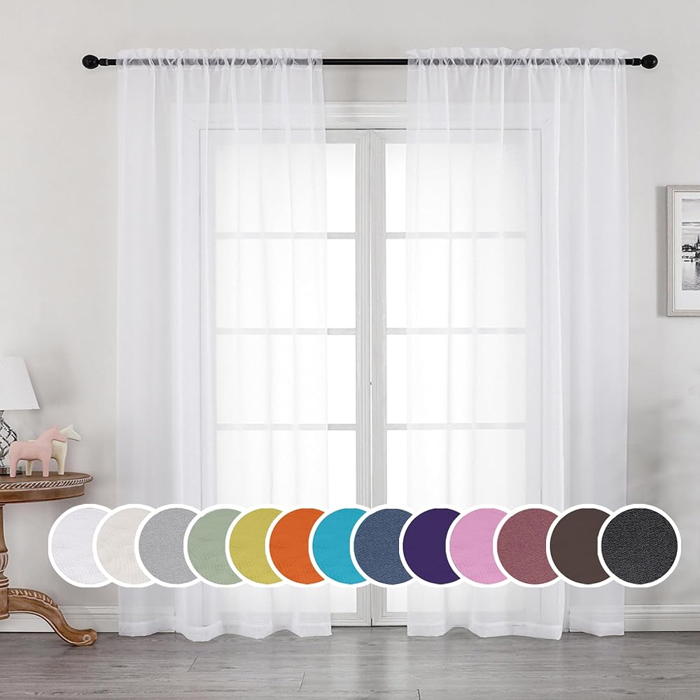
Most people hang curtain rods just above the window frame. That’s a mistake. Mount your rod 2 to 3 inches below the ceiling instead. Then extend your brackets 4 to 6 inches past each side of the window frame.
The curtains should touch the floor. A gap between the curtain hem and the floor visually cuts the wall in half. Hem them to within half an inch of the floor.
The result: your window looks bigger, your ceiling looks taller, and the wall feels continuous from top to bottom. None of this costs much. A set of curtain rods and floor-length panels from IKEA or Amazon runs $30 to $80.
Choose tall storage over wide storage. A bookcase that reaches seven feet draws the eye upward. A low, wide entertainment unit does the opposite. It pulls the eye sideways and makes the ceiling feel closer.
When buying shelving or storage, ask yourself: does this go up or does it go out? Go up.
Use vertical pattern elements. Wallpaper with vertical stripes, vertical shiplap, or tall artwork hung in pairs pulls the eye upward. Even a tall floor lamp in the corner adds vertical rhythm to a room.
Wall-mounted and floating furniture keeps the floor visible. Floating bedside tables, wall-mounted shelves, and sconce lights all show more floor, which makes the room feel larger at ground level.
Renter note: Use tension rods for curtains. No drilling needed. Command strips hold lightweight floating shelves. Both are fully removable.
When the eye travels upward, the room follows.
Where you hang the rod matters more than which curtains you choose. Here is the exact spec.
Color and Paint: It’s Not Just “Paint It White”
Almost every guide says the same thing: use light colors, especially white. That’s not wrong. But it’s incomplete.
The color matters less than you think. The relationship between colors is what actually controls how a room feels.
Cohesion matters more than any specific shade. A monochromatic palette, meaning different shades and tones of one color family, removes visual stopping points. When everything flows from one color to the next, your eye moves smoothly through the room. When there are harsh contrasts, your eye stops. And every stopping point makes the room feel more broken up and smaller.
High contrast chops a room apart. Dark trim against bright white walls creates a visual break at every corner. Painting your trim and walls the same color (or within the same family of tones) removes those breaks and makes the room feel more continuous.
Dark colors can actually help, if used correctly. A dark accent wall on the farthest wall from your entry makes the room feel wider. A lighter ceiling with darker walls makes the room feel taller. A peer-reviewed study by Odabaşioğlu and Olguntürk (2015, published in Perceptual and Motor Skills) found that under white or neutral lighting, interior spaces are perceived as more spacious. The lesson: combine cohesive color with good lighting, and the specific shade matters less.
Don’t forget the ceiling. If your walls are a soft color and your ceiling is stark white, the contrast line where they meet visually lowers the ceiling. Paint the ceiling the same color as the walls, or just one shade lighter. The room will feel taller.
Light flooring opens up the floor plane. Soft oak, light grey, or beige tones reflect more light and make the floor feel larger. If you can’t change the floor, a large light-colored area rug achieves the same effect.
Tools worth using before you commit to paint: Sherwin-Williams ColorSnap and Benjamin Moore Color Preview both let you test colors digitally before buying a drop.
Renter note: Peel and stick wallpaper from brands like Chasing Paper, Tempaper, and NuWallpaper is fully removable and comes in vertical stripe patterns that add height.
Color doesn’t expand square footage. It removes the visual interruptions that make the brain perceive a room as smaller than it is.
Lighting That Opens a Room Up (Layer It, Don’t Just Brighten It)
Dark corners are the most overlooked reason a room feels small.
When a room has one overhead light in the center, you get one pool of brightness and dark edges. Those dark corners visually “pull” the walls inward. The room shrinks.
The fix is layering, not just adding more watts.
Three types of light work together:
- Ambient light is your general source, usually overhead. It sets the base level of brightness.
- Task light is focused light for specific activities. A floor lamp next to a reading chair, a desk lamp, a lamp on a console.
- Accent light is targeted light that highlights specific areas. Under-shelf lighting, a wall sconce, an uplight behind a plant.
When you layer all three, the light spreads evenly. No dead zones. No dark corners pulling the walls in.
Light the corners specifically. A slim floor lamp in a corner is the cheapest, fastest fix for a room that feels cramped. It costs $30 to $60 and takes five minutes to set up. The corner visually opens up, and the wall feels like it steps back.
Color temperature matters. Aim for bulbs between 2700K and 3000K. That’s the warm white range. It creates depth and softness. Avoid bulbs above 4000K. Those are cool white, and they make small rooms feel flat and clinical. You want warmth, not a hospital hallway.
Reflective surfaces help distribute light. A glass coffee table, a metallic lamp base, or light-colored textiles all bounce light further into the room. You don’t need everything shiny. Just a few reflective surfaces reduce the number of shadow zones.
Research published in the International Journal of Engineering Research and Technology (2024) confirms that strategic placement of light fixtures visually expands or contracts how a space feels.
The Rently 2025 report found that 50% of renters specifically want smart lighting as a feature in their home. It’s not a nice-to-have anymore.
Renter note: Plug-in sconces require no wiring. Smart bulbs from Philips Hue, LIFX, or Govee let you control warmth and brightness without touching the fixture. LED strip lighting under shelves is battery-operated and leaves no marks.
Good lighting doesn’t just illuminate. It makes the room feel generous.
Room Lighting Checker
Select every light source you currently have in your room. See which zones are still in darkness and get the one recommendation that will help most.
Dark corners = zones pulling the walls inward
Furniture Choices That Don’t Swallow the Room
Here’s the myth you’ve probably been told: use small furniture in a small room.
It’s one of the most repeated mistakes in interior design. And it makes rooms feel worse, not better.
Three tiny chairs and a narrow loveseat create visual noise. One properly scaled sofa and a real area rug create calm. The room with fewer, correctly sized pieces feels bigger.
Exposed legs are important. When furniture has legs instead of a skirt or enclosed base, you can see the floor underneath it. That visible stretch of floor makes the room feel larger. Skirted sofas, ottomans with fabric to the floor, and fully enclosed storage units block the floor completely. Choose pieces with legs whenever you can.
Depth matters more than width. A standard sofa runs 38 to 40 inches deep. A shallow sofa runs 30 to 32 inches deep. That 8 to 10 inch difference is dramatic in a tight room. It means better circulation, clearer walkways, and a less overwhelming visual presence. Look for narrow-armed designs too. Wide, rolled arms eat space without adding comfort.
Transparent and open-frame pieces let the eye travel. A glass or acrylic coffee table doesn’t stop your sightline. Your eye moves straight through it to the floor and the wall beyond. An open-frame metal shelf does the same thing. You don’t need everything transparent, but even one or two lighter pieces in a room make a real difference.
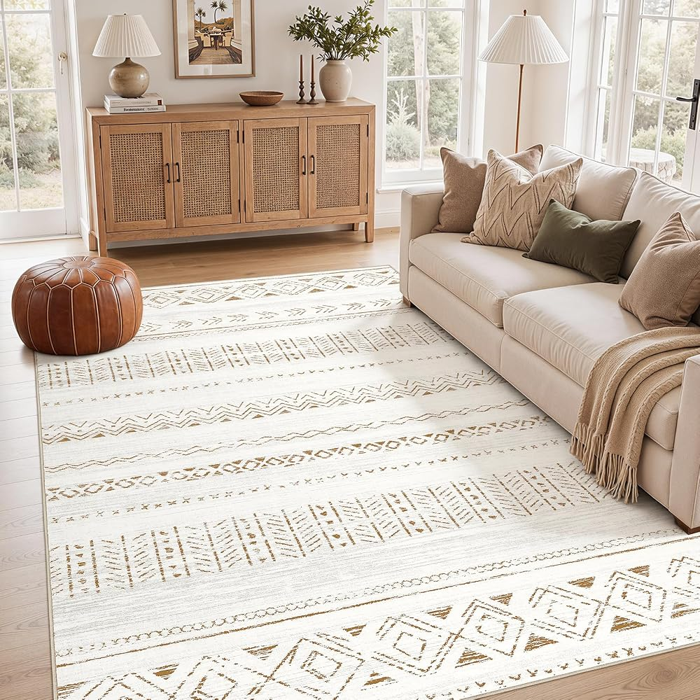
Your area rug is probably too small. This is the most common furniture mistake in small rooms. A rug that only fits under the coffee table leaves the rest of the seating floating in space. The room looks unfinished, and small.
In a living room, the rug should be large enough for at least the front two legs of every sofa and chair to sit on it. In a bedroom, the rug should extend 18 to 24 inches past each side of the bed. If you’re not sure, go one size bigger than you think you need.
The right furniture doesn’t fill a room. It anchors it, and leaves room to breathe.
The right furniture does not fill a room. It anchors it — and leaves room to breathe. Here is what to actually look for.
5 Mistakes That Are Making Your Room Feel Smaller
Before you add anything new, check if one of these five mistakes is undoing everything else.
Mistake 1: Too many small decorative items. Three small framed prints compete with each other. They create visual noise. One large piece of art anchors a wall and creates calm. In a small room, fewer and bigger beats more and smaller every time.
Mistake 2: Mirrors placed wrong. A mirror facing a closet door or a dark hallway amplifies exactly what you don’t want. Place a mirror directly across from a window instead. It doubles the natural light in the room and creates the illusion of a second window. That placement makes a real difference. Wrong placement makes things worse.
Mistake 3: Curtains that hover above the floor. Curtain hems four to six inches off the floor visually chop the wall. It’s one of the most common styling errors in home photos on social media. Full-length curtains that graze the floor aren’t just aesthetic. They’re a practical tool for making a room feel taller.
Mistake 4: Area rug too small. If your rug only fits under the coffee table, the seating area looks like it’s floating. Floating furniture makes a room feel disconnected and small. Size up.
Mistake 5: All furniture pushed against the walls. It feels like it should open up the middle of the room. It doesn’t. You end up with an awkward empty center and furniture that looks like it’s been pushed out of the way. Float at least your main piece a few inches off the wall. The room immediately feels more designed and more spacious.
Most of these take five minutes to correct. Start with the rug and the curtains. Those two changes alone make most rooms look noticeably better.
Is Your Room Making These Mistakes?
5 quick questions. Find out exactly which mistakes are making your room feel smaller, and get a ranked fix list sorted by ease.
Renter Friendly: What You Can Do Without Touching the Walls
Can’t paint. Can’t drill. Can’t make permanent changes.
That describes a huge portion of people who live in small rooms. And almost none of the advice out there accounts for it.
Here’s what actually works when you’re renting.
Peel and stick wallpaper. It’s fully removable, and it has gotten much better in the last few years. Brands like Chasing Paper, Tempaper, and NuWallpaper offer patterns with vertical stripes, light-reflective textures, and subtle colors that open a room up. It goes on like a giant sticker and comes off without damaging the wall. You can cover one wall for $60 to $120.
Tension rod curtains. No drilling. Tension rods fit inside the window frame or just outside it and hold standard curtain panels. Pair them with panels that nearly reach the ceiling, and you get the full visual height effect. No holes, no permission needed.
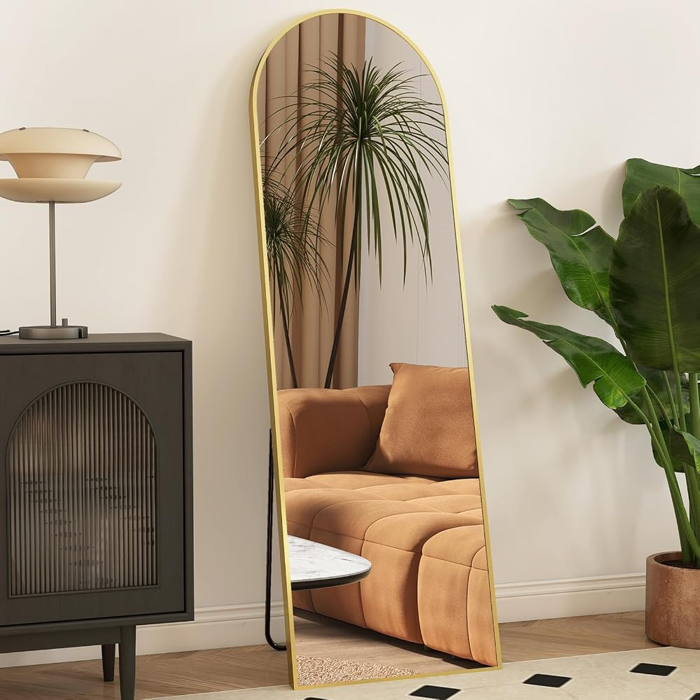
Large leaning mirrors. A full-length mirror that leans against the wall, at 65 inches tall or taller, does more work than a small mirror hung on the wall. It reflects light, adds depth, and looks intentional. IKEA’s Hovet mirror (77 inches) and similar styles lean safely without mounting.
Freestanding tall shelving. IKEA’s Billy bookcase stands 79 inches tall. The Kallax series can be stacked or extended vertically. Tall open bookshelves reach toward the ceiling and maximize vertical storage without touching the wall permanently. Fill them with a mix of books, plants, and objects for the best look.
Lighting without wiring. Plug-in pendant lights hang from a hook and plug into any outlet. Plug-in wall sconces do the same. Under-shelf battery LED strips (Govee, Lepro, and similar brands) add accent lighting anywhere. All of these are renter-safe and leave no trace when removed.
The Rently 2025 report found that 45% of renters rearrange furniture, 37% bring in plants, and 32% tackle DIY projects to improve their spaces. Creativity really does thrive within restrictions.
You don’t need to own the space to make it work for you. Every tip in this section is reversible, removable, and landlord-safe.
Where to Start Right Now
If you only do three things, do these:
First, fix the layout. It’s free and you can do it today. Pull furniture off the walls. Clear your walkways. Move your focal point to the farthest wall from the door.
Second, layer your lighting. Buy one corner floor lamp. That single change removes the dead zone that’s making your room feel cramped. It costs $30 to $60.
Third, size your rug correctly. If your rug is too small, everything floating above it looks disconnected. A properly sized rug unifies the space and makes the room feel finished.
Those three changes alone will make your small room look and feel noticeably bigger. No renovation. No big budget. No guessing.
Start with layout today. Move one piece of furniture right now and see how the room changes.
Sources used in this article:
- RentCafe / Yardi Matrix, National Average Apartment Size Report, 2025
- Rently, 2025 Apartment Design and Decor Trends Report
- Prykhodko, O. (2025), “Psychology of Space Perception,” ULETE Journal, Vol. 2(2)
- VirtualSpaces.tech, “The Psychology of Space: How Room Dimensions Influence Interior Design,” February 2026
- PLOS One, “The Effect of Furnishing on Perceived Spatial Dimensions and Spaciousness of Interior Space,” 2014
- Odabasioglu and Olguntürk, “Effects of Coloured Lighting on the Perception of Interior Spaces,” Perceptual and Motor Skills, 2015
- IJERT, “Luminary Landscape: A Study of Modern Architects Mastery of Natural Light,” 2024
- Coohom / Avery Chen NCIDQ, Small Space Interior Design Guide, 2025
Small-Space Picks That Help
Related Guides

Olivia Bennett is the Lead Content Editor at The Dailey House. She specializes in interior styling, bedroom aesthetics, and creating spaces that feel intentional without feeling out of reach. With over a decade of experience covering home interiors, Olivia believes every room should tell you something about the person who lives in it.