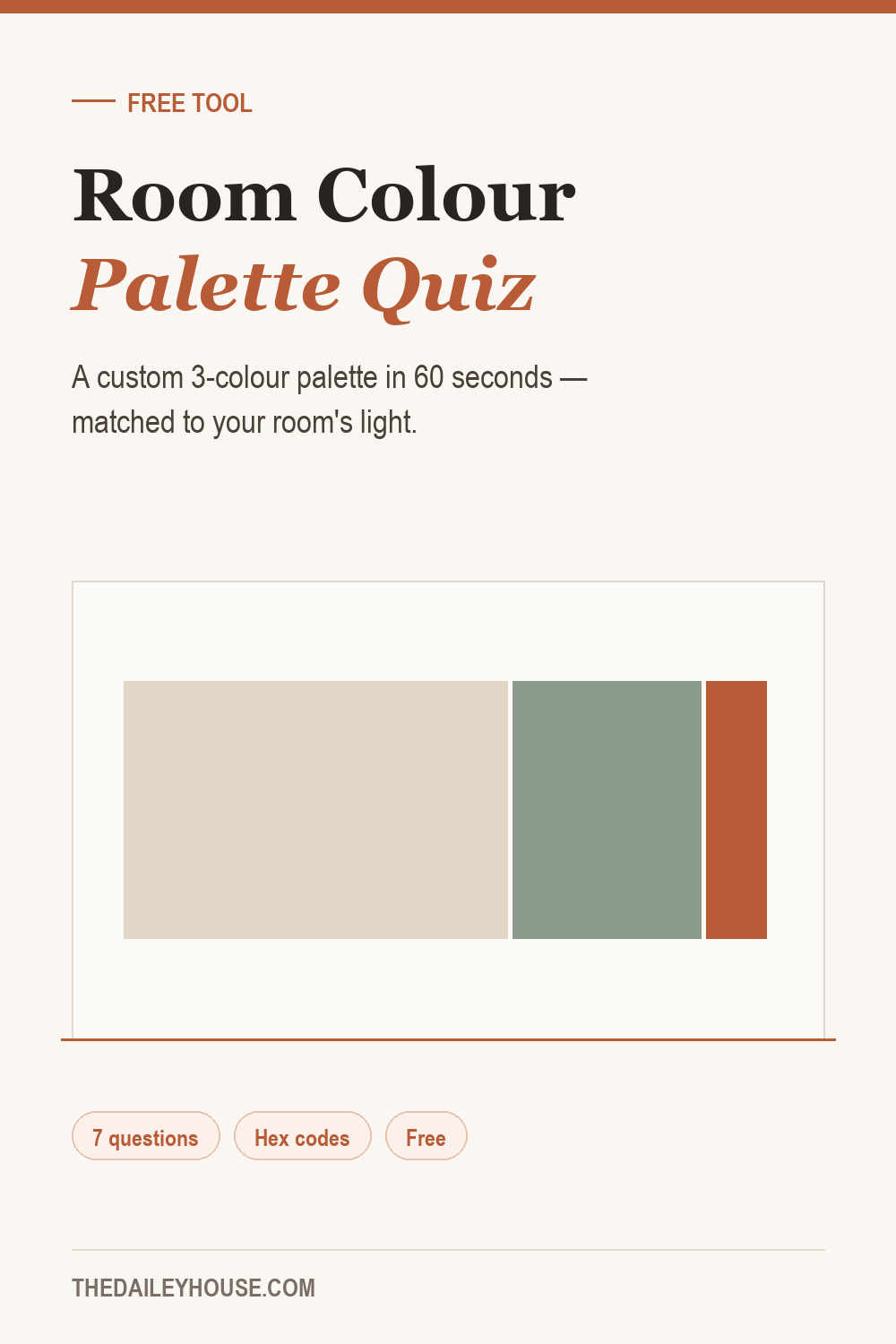
Free Quiz

Find Your Perfect Room Colour Palette in 60 Seconds

Answer 7 questions about your room's light, size, mood, and style. Get a personalised 3-colour palette with exact paint names, hex codes, and a room-by-room application guide — tailored to your space.

7 questions, ~60 seconds
12 unique palette results
Free, no sign-up
YOUR PALETTE REVEALED BELOW
Colour Rule

The 60-30-10 Rule — How Every Great Palette Works

Every well-designed room uses three colours in a specific ratio. This is the rule professional designers always follow — and the reason some rooms feel instantly right while others feel off.

60
60% — Dominant
Your Main Colour
The walls, large furniture, and floor coverings. This colour sets the overall tone of the room. Usually a neutral or a muted version of your chosen colour family.
30
30% — Secondary
Your Supporting Colour
Curtains, bed linen, rugs, upholstered chairs. This colour complements the dominant and adds depth. Usually a step deeper or a complementary tone.
10
10% — Accent
Your Accent Colour
Cushions, vases, art, lamp shades. This is your boldest colour — the one that gives the room personality. Used sparingly so it stays impactful.
Undertone Guide

Understanding Colour Undertones

The most common reason a paint colour looks wrong on your walls is undertones. Every paint has one — and understanding this will transform how you choose colour.

Warm undertone
Yellow / Cream
Whites and neutrals with yellow undertones glow under warm lighting. They look inviting and cosy but can read as dirty next to pure whites.
Pairs with: warm woods, brass, terracotta
Warm undertone
Pink / Red
Adds warmth and energy. Beautiful in dining rooms and kitchens. Can look overly rosy under cool light — always sample on your wall first.
Pairs with: warm neutrals, gold, copper
Cool undertone
Green / Sage
The most versatile cool undertone. Green-based neutrals read as calm and organic. Work beautifully in almost any light condition.
Pairs with: natural wood, linen, matte black
Cool undertone
Blue / Violet
Feels modern, clean, and sophisticated. Can look cold in north-facing rooms — warm it up with timber, linen, and warm-toned lighting.
Pairs with: crisp whites, chrome, cool greys
Mistakes to Avoid

Colour Mistakes Everyone Makes

01

Choosing from a chip, not a sample

Paint chips are tiny, lit by store lighting, and surrounded by other colours. They are almost useless on their own. Always buy a sample pot and paint at least a 30×30cm patch on your actual wall before committing.

02

Not checking at different times of day

A colour that looks perfect at 10am can look completely different under evening artificial light. Observe your sample in morning, afternoon, and artificial light before buying.

03

Matching instead of coordinating

A room where everything matches exactly — wall colour, cushions, art — looks flat and contrived. Coordinate through undertone and tone, not exact colour matches.

04

Ignoring the ceiling and trim

Walls are only part of the palette. The ceiling and trim are the 30% and they matter. Pure brilliant white trim next to a warm cream wall looks jarring — match the warmth of your trim to your wall colour.

Colour by Room

Best Colours for Every Room

Living Room

The living room needs to work from bright morning through evening entertaining. Warm neutrals and muted greens are the most forgiving. Avoid very pale cool greys — they look flat under artificial light.

Designer tip: Paint the ceiling 1–2 shades lighter than your walls, not pure white. This creates a cohesive, enveloping feel rather than a ceiling that feels slapped on.

Bedroom

Bedrooms benefit most from colours that are calming and slightly saturated — they look better in low light and help signal to your brain that it's time to wind down. Sage green, dusty blue, and warm taupe are consistently the most popular bedroom colours.

Kitchen & Dining

  • Warm whites and creams make food look more appetising — avoid cool blues in food preparation areas.
  • Deep, saturated colours on a kitchen island or lower cabinets add drama without overwhelming the space.
  • Dining rooms can handle the boldest colours in the house — you're only in them for meals, so drama works.

Home Office

Blue and green tones genuinely support focus and productivity according to colour psychology research. Avoid red and orange in spaces where you need concentration — they increase arousal and make sustained work harder.


FAQ

Colour Palette Questions, Answered


Start with what you already have — floors, large furniture, and any fixed elements. These set the undertone constraints for your palette. Then choose a wall colour that either harmonises with those undertones (same warmth) or deliberately contrasts (warm furniture, cool walls). Pick three colours following the 60-30-10 rule and always sample on the actual wall before buying in full. Take the quiz above for a personalised recommendation based on your specific room.
Light colours reflect more light and make walls appear to recede, which creates the illusion of space. Very pale warm whites, soft creams, and light greiges are the most effective. Painting the ceiling the same colour as the walls (rather than bright white) also makes the room feel taller. Contrary to popular belief, a bold dark colour can also work in a small room — it creates intimacy rather than the appearance of size, which can feel intentional and cosy rather than cramped.
The dominant trend in 2026 is warm-toned neutrals — particularly warm whites, oat linens, and biscuit tones. These replaced the cool grey dominance of the 2010s. Alongside warm neutrals, sage green remains extremely popular (it's been in the top 3 for four consecutive years), and deeper, moodier tones like forest green, navy, and warm terracotta continue to grow for people wanting more personality. Pinterest data shows searches for "warm beige living room" and "sage green bedroom" at all-time highs.
Hold the chip next to a pure brilliant white — if your white looks cream, yellow, or pink by comparison, it has a warm undertone. If it looks grey, blue, or lavender, it has a cool undertone. Another trick: look at the chip in different light sources. Warm whites glow under incandescent or warm LED bulbs. Cool whites look crisp and bright under daylight bulbs. Always test against the other whites already in your room — mismatched whites are immediately noticeable.
You don't need to use the same colour — but you should use colours from the same tonal family so the home flows. Choose a consistent undertone (all warm or all cool) across your main living spaces, then vary the depth and saturation by room. Hallways and transitional spaces look best in a neutral that sits between the rooms it connects. Each room can have personality while still feeling like part of the same home.
North-facing rooms receive cool, indirect light all day — this makes cool grey and blue tones look flat and cold. The best solution is warm undertones: creamy whites with yellow undertones, warm taupes, soft terracotta, and sage greens all perform much better than cool neutrals in north-facing light. You can still use cool tones, but go significantly warmer than you think necessary — the light will cool them down considerably in practice.

More Free Tools

Other Tools You'll Find Useful