

The Dailey House is supported by readers. When you purchase through links on our site, we may earn an affiliate commission at no extra cost to you. As an Amazon Associate, we earn from qualifying purchases.
If you’ve noticed your mattress developing an annoying dip in the middle, or you wake up every morning rolling toward the center of your bed with a stiff lower back, you aren’t necessarily dealing with a worn-out mattress. In over 80% of sagging bed complaints, the true culprit lies directly underneath: compromised, bowing, or entirely missing bed slat support center legs.
Modern platform beds and wooden slatted frames look sleek and minimalist, but many factory designs ship with flimsy wooden center pegs or rely solely on horizontal pine cross-slats spanning 60 inches (Queen) or 76 inches (King) without adequate center bracing. When you combine modern multi-layer hybrid, latex, or dense memory foam mattresses—which easily weigh 120 to 160 pounds on their own—with the weight of two sleeping adults, unsupported center slats deflect downward by up to two inches. Over time, this chronic deflection causes structural wood fatigue, noisy squeaks and groans with every movement, and irreversible mattress damage that voids your manufacturer warranty.
Installing heavy-duty adjustable bed slat center support legs provides immediate, bedrock reinforcement. These telescopic steel and reinforced alloy supports prop up your frame’s center spine, distribute concentrated sleeper weight directly into the floor, eliminate nocturnal creaks, and permanently restore a level, posture-correct sleeping plane without requiring an expensive new bed frame.
Quick Comparison: Best Bed Slat Support Center Legs
Compare height adjustment range, weight capacity, mounting architecture, and key structural features across our top-tested bed frame center supports.
| Brand & Model | Height Range | Weight Capacity | Mounting Type | Key Strength | Check Price |
|---|---|---|---|---|---|
| Regaluli T-Shaped Steel Legs | 7.08″ to 13.4″ | 1,200 lbs (4-Pack) | Screw-in or Clamp Plate | Broad 4.3″ T-bracket & swivel glide | Check Price |
| Mainiusi Adjustable Bed Legs | 5.9″ to 9.8″ | 1,000 lbs (4-Pack) | Direct Slat Screw Mount | Low-profile platform frames & locking nut | Check Price |
| BQLZR Telescopic Industrial Legs | 7.8″ to 14.5″ | 1,500 lbs (4-Pack) | Universal Clamp / Bolt | Heavy cold-rolled alloy & wide footprint | Check Price |
| KCHEX Center Rail System | 6.5″ to 15.5″ | 1,800 lbs total | Side-Rail Steel Clamp | Full cross-beam support for beds lacking center spine | Check Price |
The Physics of Mattress Sag: Why Bed Centers Fail
Understanding why bed frames fail requires looking at basic structural beam mechanics. A standard queen bed measures 60 inches wide by 80 inches long; a king bed measures 76 inches wide. When a mattress rests on simple horizontal wooden cross-slats, those slats act as unsupported horizontal beams supported only at the far left and far right side rails.
According to beam deflection formulas in mechanical engineering, the deflection ($delta$) of a centrally loaded beam increases with the cube of its span length ($L^3$). That means doubling the span of a wooden slat doesn’t just double the sag—it increases deflection by a factor of eight! In queen and king beds lacking a center support column:
- Point Load Concentration: Over 70% of human body weight is concentrated between the shoulders and hips. When two sleepers lie side by side, their heaviest body mass rests directly over the exact center midpoint of the bed slats.
- Dynamic Fatigue in Softwood Slats: Most factory platform beds use 3/4-inch spruce or pine slats. Repeated downward compression causes micro-fractures along the wood grain, permanently bowing the slats downward into a concave dish shape.
- Racking and Joint Stress: As the center sags, the side rails are pulled inward toward the center of the room. This torsional twisting loosens corner bracket bolts and causes the grating wood-on-wood squeaks examined in our detailed guide on how to fix a squeaky bed frame on a wood floor.
- Warranty Compliance: Leading mattress manufacturers like Tempur-Pedic, Casper, and Purple explicitly state in their warranty contracts that queen and king frames must have a rigid center support beam with at least one to three vertical legs making solid contact with the floor. Without center legs, warranty claims for mattress sagging are routinely denied.
Materials Science: Cold-Rolled Steel vs. Cast Iron vs. Reinforced Nylon
When selecting aftermarket bed support legs, the metallurgical and polymer composition of the leg determines both its static load tolerance and long-term fatigue resistance. The three primary materials used in modern bed center supports offer distinct performance profiles:
- Cold-Rolled Carbon Steel (Best for Heavy Hybrid & Latex Mattresses): Formed at room temperature below its recrystallization state, cold-rolled steel exhibits an extraordinarily high yield strength (typically exceeding 350 MPa). It resists vertical column buckling under concentrated compressive loads and does not flex when sleepers shift weight. Look for wall thicknesses of at least 1.5mm to 2.0mm in telescoping cylinders to ensure lifelong stability.
- High-Impact Polymer & Reinforced Nylon (Best for Budget & Rental Setups): Industrial-grade polymers engineered with glass-fiber reinforcement offer impressive compressive strength while being 100% impervious to rust and oxidation. However, plastic threads are susceptible to cross-threading if installed at an angle and can creep or deform under sustained high temperatures near baseboard heating radiators.
- Solid Cast Iron Flanges (Best for Heavy Antique Frames): Vintage cast-iron brackets offer tremendous mass and zero flex, making them ideal for heavy solid-oak or iron bed frames. The main caveat with cast iron is brittleness under sharp dynamic impacts; ensure cast fittings are paired with dense rubber dampening pads to prevent shock fractures.
Advanced Bed Frame Reinforcement: Sistering Wooden Slats & Center Spines
In cases where factory wooden slats have already begun to crack or bow significantly, installing center legs alone may not provide 100% rigid support. Combining new center legs with simple wood sistering restores factory-new stiffness:
- Sistering Weakened Slats: If a specific 1×3 pine slat has developed a longitudinal crack, purchase a 1×3 piece of dense kiln-dried yellow pine or oak from your local lumber yard. Cut it to the same length as the existing slat, apply structural wood glue between them, and clamp them together with 1.25-inch wood screws every 6 inches. This doubles the cross-sectional moment of inertia, completely eliminating bounce.
- Installing a Longitudinal Center Spine: For queen frames that only feature horizontal slats spanning from side to side without a center spine, add a 2×4 lumber beam running lengthwise down the center from the headboard to footboard. Mount your adjustable center support legs directly to the underside of this new 2×4 spine to create an unbreakable backbone.
- Vibration-Damping Felt Washers: When screwing metal support brackets directly against dry wooden slats, insert thin dense wool felt washers or strips between the steel plate and the wood. This absorbs micro-friction and prevents the annoying dry creaks that occur when wood rubs against powder-coated metal under body movement.
Detailed Reviews: The 4 Best Bed Slat Support Center Legs
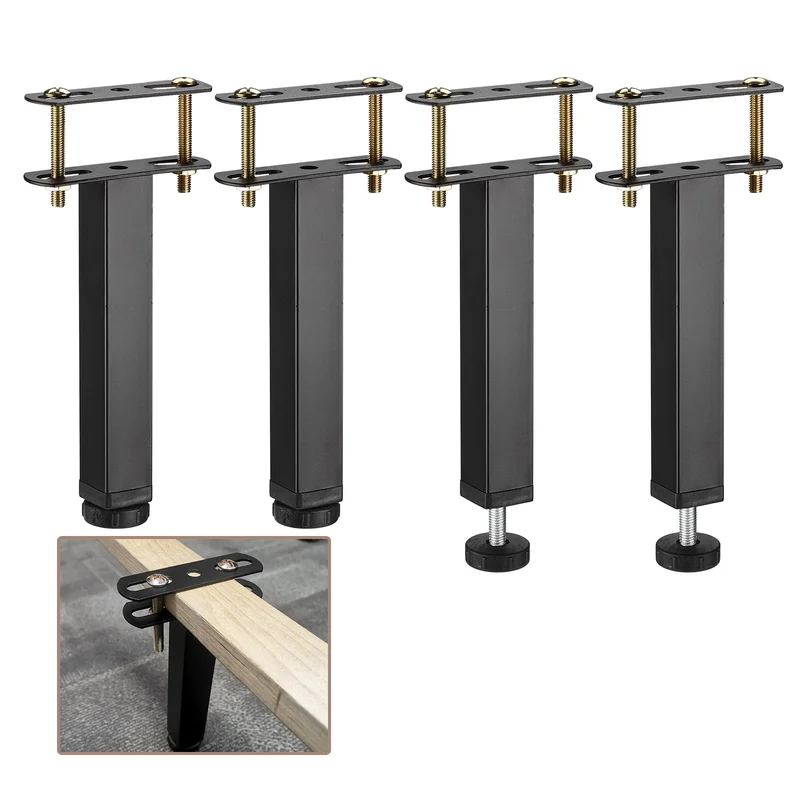
Regaluli Heavy-Duty T-Shaped Steel Bed Slat Support Legs (4-Pack)
The Regaluli Heavy-Duty T-Shaped Support Legs represent the gold standard in bed frame stabilization. Featuring an oversized 4.3-inch horizontal mounting flange, these legs distribute downward mattress pressure across a broad swath of wood slat grain, preventing the splitting and fastener pullout common with narrow single-bolt legs.
- Broad 7.08″ to 13.4″ Telescopic Range: The threaded steel adjustment rod lets you fine-tune clearance by millimeter increments to achieve rock-solid floor contact regardless of room settling.
- Dual Installation Flexibility: Can be screwed directly into wooden slats using the included wood screws, or clamped around metal bed beams using the secondary clamp plate without drilling.
- Cold-Rolled Carbon Steel Construction: Thick-walled steel tubing withstands up to 1,200 pounds of distributed weight across a 4-leg configuration.
- Floor-Protecting Swivel Foot: Base features a high-density non-marring PVC pad that pivots slightly to accommodate uneven hardwood floorboards without gouging finishes.
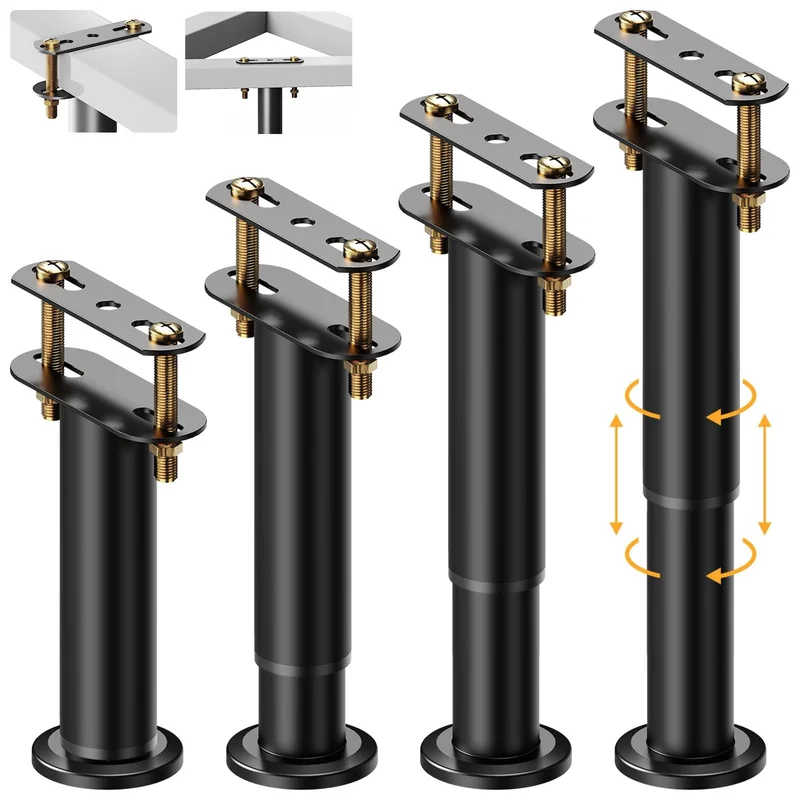
Mainiusi Adjustable Bed Slat Support Legs (4-Pack)
Low-profile Scandinavian platform beds often sit closer to the ground, with floor-to-slat clearances between 6 and 9 inches where standard 12-inch replacement legs simply cannot fit. The Mainiusi Adjustable Bed Legs are specially engineered for compact clearances, providing a streamlined 5.9″ to 9.8″ adjustable span with an integrated anti-slip locking nut.
- Low-Clearance Precision: Collapses down to 5.9 inches, making it ideal for modern minimalist platform bed frames, tatami platforms, and low-slung guest beds.
- Anti-Backoff Jam Nut: Features a heavy-duty threaded locking collar. Once you adjust the foot to touch the floor, tightening the jam nut prevents vibration and sleeper movement from loosening the threads over time.
- Reinforced Triple-Hole Plate: Sits securely against wooden slats with three counter-sunk screw positions that prevent rotation or twisting under lateral bed movement.
- Protective Rubber Floor Foot: Thick non-marking rubber pad absorbs impact shocks and prevents scratches on delicate polyurethane hardwood flooring.
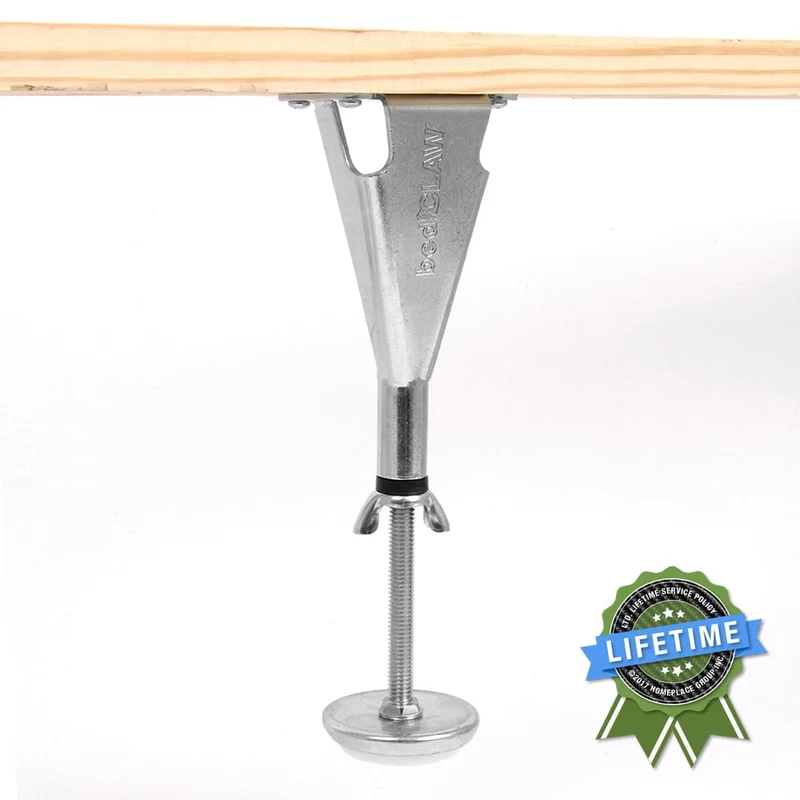
BQLZR Telescopic Industrial Metal Bed Support Legs (4-Pack)
If you have a heavy king-size hybrid mattress, an adjustable power base, or multiple larger sleepers sharing the bed, standard furniture hardware won’t cut it. The BQLZR Telescopic Industrial Support Legs are constructed from commercial-grade cold-rolled alloy steel rated to support a staggering 1,500 pounds across four support points.
- Heavy 1,500-Pound Load Rating: Industrial steel wall thickness exceeds standard factory legs by over 40%, resisting column buckling under intense downward pressure.
- Extended 7.8″ to 14.5″ Telescoping Height: Accommodates taller traditional bed frames, box spring foundations, and raised frames with plenty of under-bed clearance.
- Electroplated Rust-Resistant Coating: Matte black industrial powder-coat prevents oxidation and corrosion even in humid coastal bedrooms or ground-floor apartments.
- Extra-Wide 2.4-Inch Footprint: Large base plate disperses point pressure evenly across hardwood or subfloors, preventing deep indentations in timber or vinyl flooring.
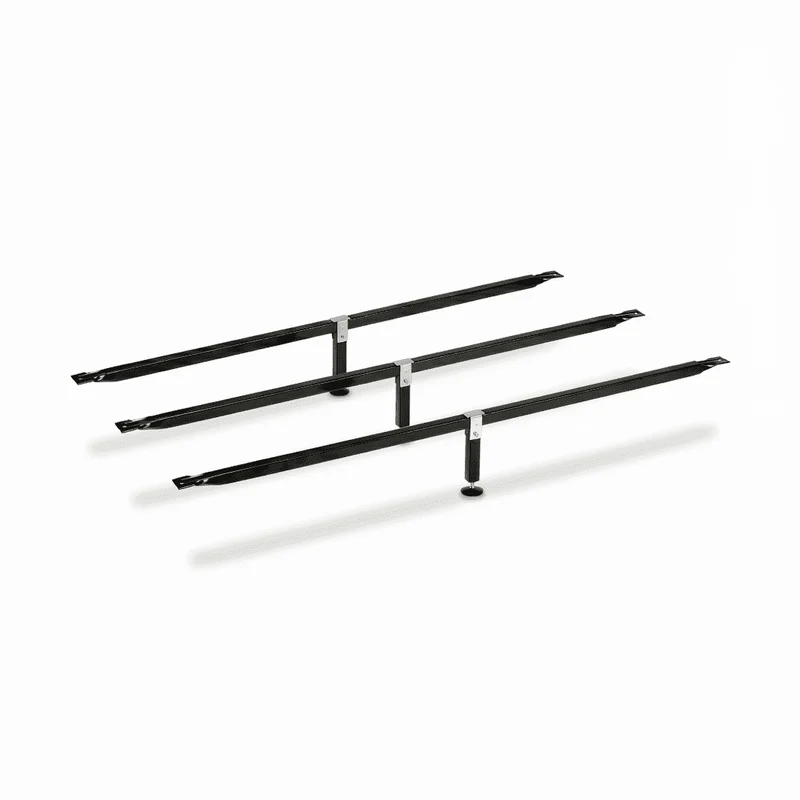
KCHEX Universal Bed Frame Center Support Cross Rail System
What if your bed frame doesn’t have an existing center spine to screw individual legs into? Many older wooden beds and antique headboard/footboard setups only have outer wooden side rails with a few loose cross-slats. The KCHEX Universal Center Support System provides a complete structural overhaul, adding a heavy-gauge steel cross-beam with multiple integrated vertical center support legs.
- Converts Unsupported Frames: Bridges the full width of Full, Queen, King, or California King frames, clamping directly onto the wooden side lips.
- Multiple Adjustable Vertical Legs: Includes heavy-duty telescoping steel center legs that adjust from 6.5″ to 15.5″ to ground the entire structure solidly into the floor.
- 1,800-Pound System Capacity: Transforms a weak decorative bed into an ultra-rigid platform capable of handling modern memory foam, hybrid mattresses, or heavy box springs.
- Prevents Side Rail Bowing: Tension clamps pull the outer bed rails into rigid alignment, preventing them from spreading outward and dropping slats in the middle of the night.
Step-by-Step Installation: How to Measure and Install Center Support Legs
Installing replacement or reinforcement bed legs is an easy 20-minute DIY project, but measuring accurately is paramount to avoid creating a bed that teeters like a seesaw. Follow these four professional installation steps:
Step 1: Measure Floor-to-Slat Clearance Under Load
Never measure the distance with an empty, stripped bed frame. Remove your bedding, but leave the mattress in place (or have someone sit on the bed) so the slats are slightly compressed into their natural loaded position. Use a rigid metal tape measure to check the exact vertical clearance from the floor surface to the underside of the center slat or spine at three locations: near the headboard, at the center midpoint, and near the footboard. In older homes with sloped hardwood floors, these three measurements can vary by up to half an inch!
Step 2: Choose Between Direct Screw-In vs. Clamp Mounting
- Direct Screw-In (Wooden Slats): If your bed features solid wood slats or a wooden longitudinal center beam, align the mounting flange along the center axis. Pre-drill small pilot holes using a 1/8-inch drill bit to prevent splitting the wood, then drive in 1-inch or 1.25-inch heavy-duty wood screws.
- Clamp-On Mounting (Metal Frames or Thin Slats): If your bed has a hollow metal tubular spine or thin composite slats you don’t want to drill into, use the included auxiliary clamp plate. Sandwich the slat between the top clamp plate and bottom leg flange, securing them with the through-bolts and locking nuts.
Step 3: Adjust the Telescoping Height to “Snug Contact”
Extend the threaded foot until it makes firm contact with the floor. You want firm, snug pressure—do not over-extend the leg so much that it jacks the bed up and lifts the four outer corner posts off the floor! Once the foot touches the floor firmly, hand-tighten the adjustment cylinder and tighten the locking jam nut securely against the upper housing with an adjustable wrench to prevent back-off vibration.
Step 4: Protect Hardwood Floors and Room Transitions
Center support legs concentrate immense downward force onto a tiny 2-to-3 inch circle of floor. On bare hardwood flooring, this point load can crush polyurethane finishes and dent softer woods like pine or birch. Stick a heavy-duty dense felt furniture pad to the bottom of each center leg base.
Additionally, take note of your bedroom area rug placement. If your bed frame sits halfway onto an area rug, your center support legs might land on the rug border or on bare wood. To ensure your bed posts and center legs sit on a uniform, level plane without tilting, reference our foundational guide on area rug sizes for queen and king beds. If your outer bed posts tend to slide when entering or exiting bed, pair your new center legs with non-slip rubber bed stoppers for hardwood floors, and if you plan to raise your entire frame for under-bed storage, explore our reviews of the best heavy-duty bed risers with outlets to ensure your center legs maintain proper floor contact.
Frequently Asked Questions About Bed Slat Support Center Legs
How many center support legs does a queen or king bed need?
A standard queen bed requires at least one central longitudinal support beam equipped with 2 to 3 vertical center legs making contact with the floor. A king or California king bed, due to its massive 76-inch width, requires a minimum of 3 to 5 center support legs (or a cross-beam system with multiple ground contact points) to prevent chronic mattress center sagging and maintain warranty compliance.
Can I install center support legs on an existing bed without drilling?
Yes! Many models (including the Regaluli T-Shaped Legs and BQLZR Legs) come equipped with secondary clamp plates and through-bolts. These plates sandwich around your existing bed slats or metal center rails, clamping down with heavy wing nuts or hex bolts without requiring you to drill pilot holes into your furniture.
Why do my bed support legs keep loosening and falling over?
Center legs loosen over time due to two primary factors: dynamic sleeper movement that unscrews un-locked threaded cylinders, and horizontal bed shifting across smooth floors. Always choose support legs with an integrated anti-backoff locking jam nut that cinches the threaded cylinder tight. Furthermore, ensure the base foot features a non-slip rubber grip that prevents the bottom of the leg from kicking out sideways when someone sits heavily on the bed.
Will adding center legs fix an already sagging mattress?
If your mattress is sagging because the underlying wooden slats are bowing downward, adding center support legs will immediately push the slats back to a level horizontal plane and restore proper support. However, if your mattress’s internal foam or coil layers have experienced permanent internal foam breakdown or severed pocket coils from years of unsupported use, the mattress core itself may need replacement alongside the new bed legs.
What should I do if my floor is uneven under the bed?
In older homes, wooden floorboards frequently slope toward room walls or dip near the center of the room. This is why threaded telescoping legs are vastly superior to fixed-length wooden replacement pegs. You can adjust each center leg individually by 1/8-inch increments to ensure each leg makes 100% solid, weight-bearing contact with the floor without rocking or leaving a floating gap.

Olivia Bennett is the Lead Content Editor at The Dailey House. She specializes in interior styling, bedroom aesthetics, and creating spaces that feel intentional without feeling out of reach. With over a decade of experience covering home interiors, Olivia believes every room should tell you something about the person who lives in it.